This radical math solver solves equations with a square root in them, such as sqrt(x + 6) = x. It isolates the root, squares both sides, solves what is left, and then checks each answer in the original equation, because squaring can create answers that do not work. Type the equation or take a photo.
photo
We read the problem from the picture.
or type it
Free: 3 problems a day. Sample problems never count.
Recent
Try a sample
TypedStandard method
Answer
AI can make mistakes. Check the work, especially signs and units.
We read:Wrong? Edit the text box and solve again.
You've used today's 3 free solves
Come back tomorrow, or go unlimited with Plus: every step explained, another method on demand, save solutions as images.
The method has four moves. First get the square root alone on one side. Second, square both sides, which removes the root. Third, solve the equation that results, often a quadratic. Fourth, put every answer back into the original equation. This radical math solver follows those moves and writes the check as its own step.
Why the check is not optional
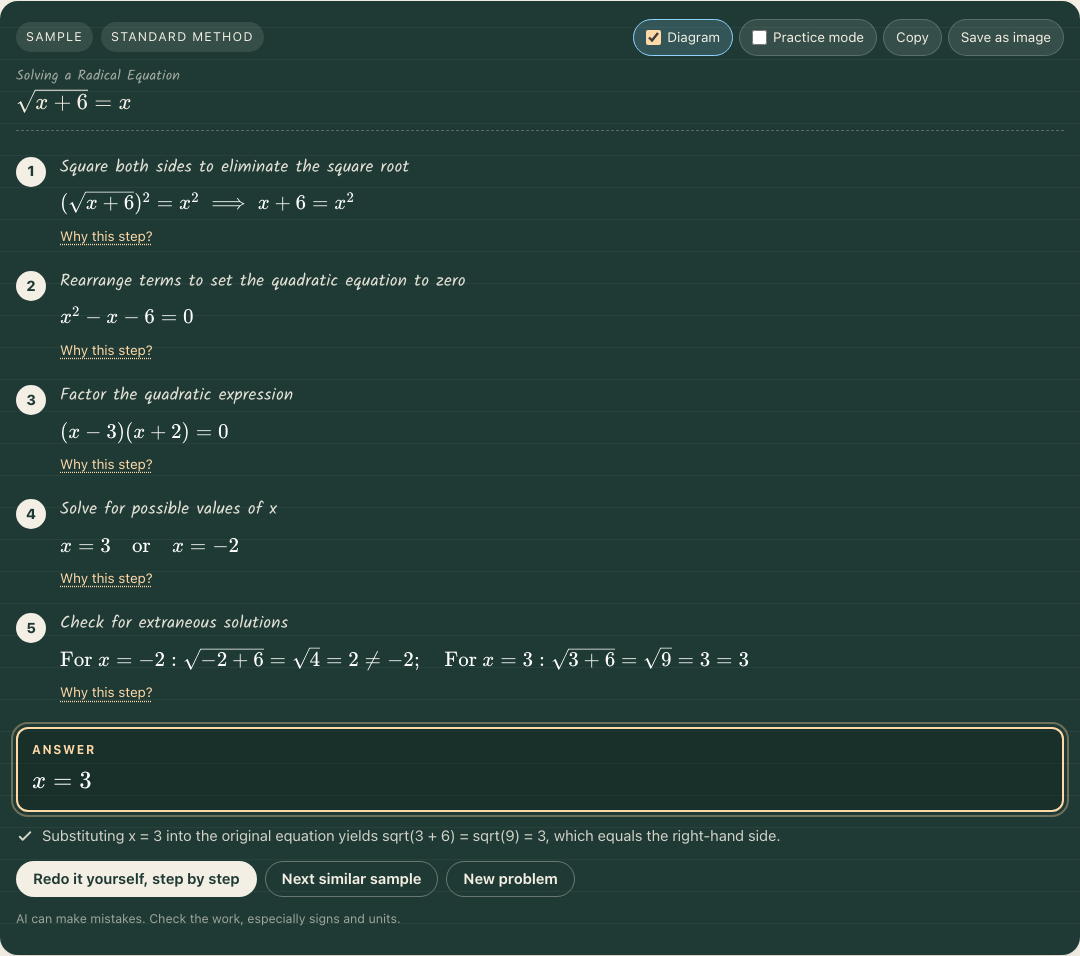
Squaring is not reversible. The equations x = 3 and x = −3 are different, but both become x² = 9 when squared. So after squaring, the new equation can have answers the original does not. Two things are always true about the original: the expression under the root must be zero or more, and the value of a square root is never negative. In sqrt(x + 6) = x the right side is the root, so x must be 0 or more. The squared equation gives x = 3 and x = −2, and the second one fails: sqrt(4) is 2, not −2. Only x = 3 is a solution.
How to use it
Type the square root as sqrt( ) with the whole expression inside the brackets, for example sqrt(x + 5) + 1 = x.
Read how the solver isolates the root before squaring.
Look at the check for extra answers. Each answer is put back into the original equation.
Keep only the answers that pass, and make sure the expression under the root is not negative.
Radical math solver: worked examples with checks for extra answers
Each example is the solver's own output for the equation shown. We also worked every one by hand, and the answers match. Use the link under an example to run it on the board above.
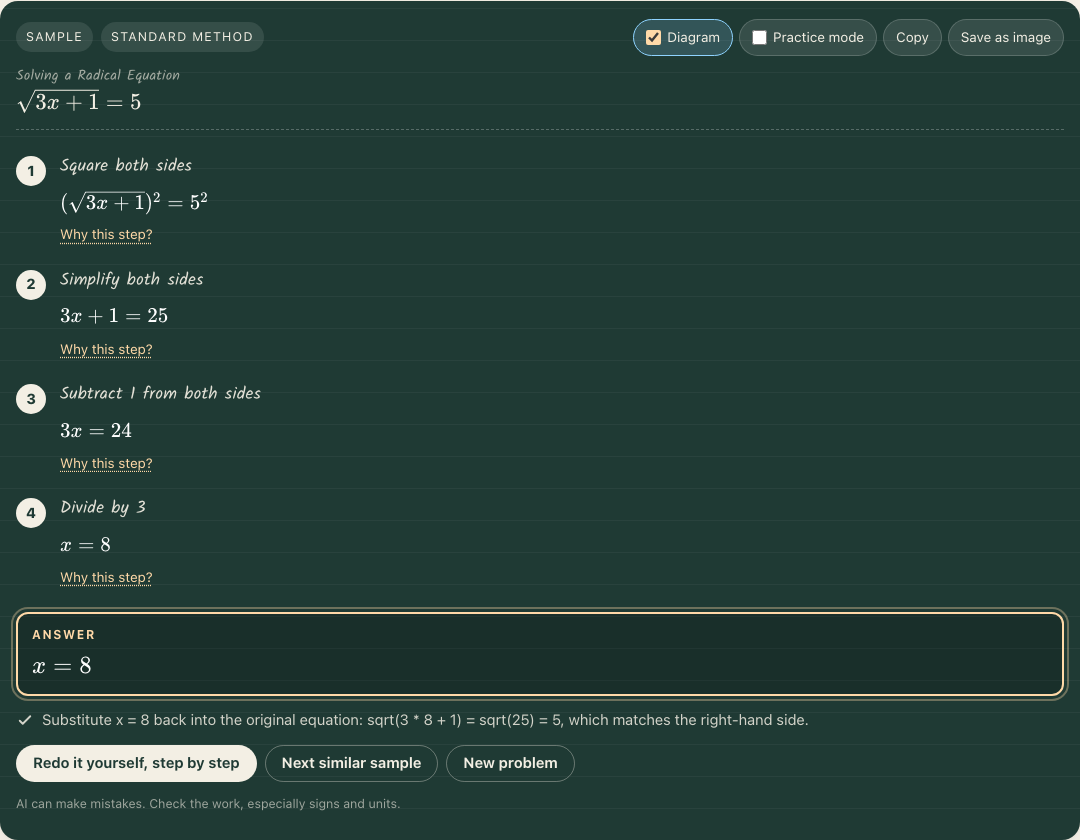
1. Solve sqrt(3x + 1) = 5
Square both sides(sqrt(3x + 1))^2 = 5^2Squaring both sides eliminates the square root on the left. The root must be defined, so 3x + 1 must be at least 0 (x ≥ −1/3); the right side, 5, is already non-negative.
Simplify both sides3x + 1 = 25Evaluate the square on both sides.
Subtract 1 from both sides3x = 24Subtract 1 from both sides to isolate the term with the variable.
Divide by 3x = 8Divide both sides by 3 to solve for x.
Answer:x = 8
Check: Substitute x = 8 back into the original equation: sqrt(3 * 8 + 1) = sqrt(25) = 5, which matches the right-hand side.
Square both sides to eliminate the square root(sqrt(x + 6))^2 = x^2 implies x + 6 = x^2Squaring both sides removes the radical. The root needs x + 6 ≥ 0 and its value is never negative, so any answer must also satisfy x ≥ 0. Squaring can add solutions that break this, so we check at the end.
Rearrange terms to set the quadratic equation to zerox^2 - x - 6 = 0Subtract x and 6 from both sides to write the quadratic equation in standard form.
Factor the quadratic expression(x - 3)(x + 2) = 0Find two numbers that multiply to -6 and add to -1, which are -3 and 2.
Solve for possible values of xx = 3 or x = -2Set each linear factor equal to zero using the zero product property.
Check for extraneous solutionsFor x = -2: sqrt(-2 + 6) = sqrt(4) = 2 != -2; For x = 3: sqrt(3 + 6) = sqrt(9) = 3 = 3The principal square root must be non-negative, so x = -2 is an extraneous solution, leaving only x = 3.
Answer:x = 3
Check: Substituting x = 3 into the original equation yields sqrt(3 + 6) = sqrt(9) = 3, which equals the right-hand side.
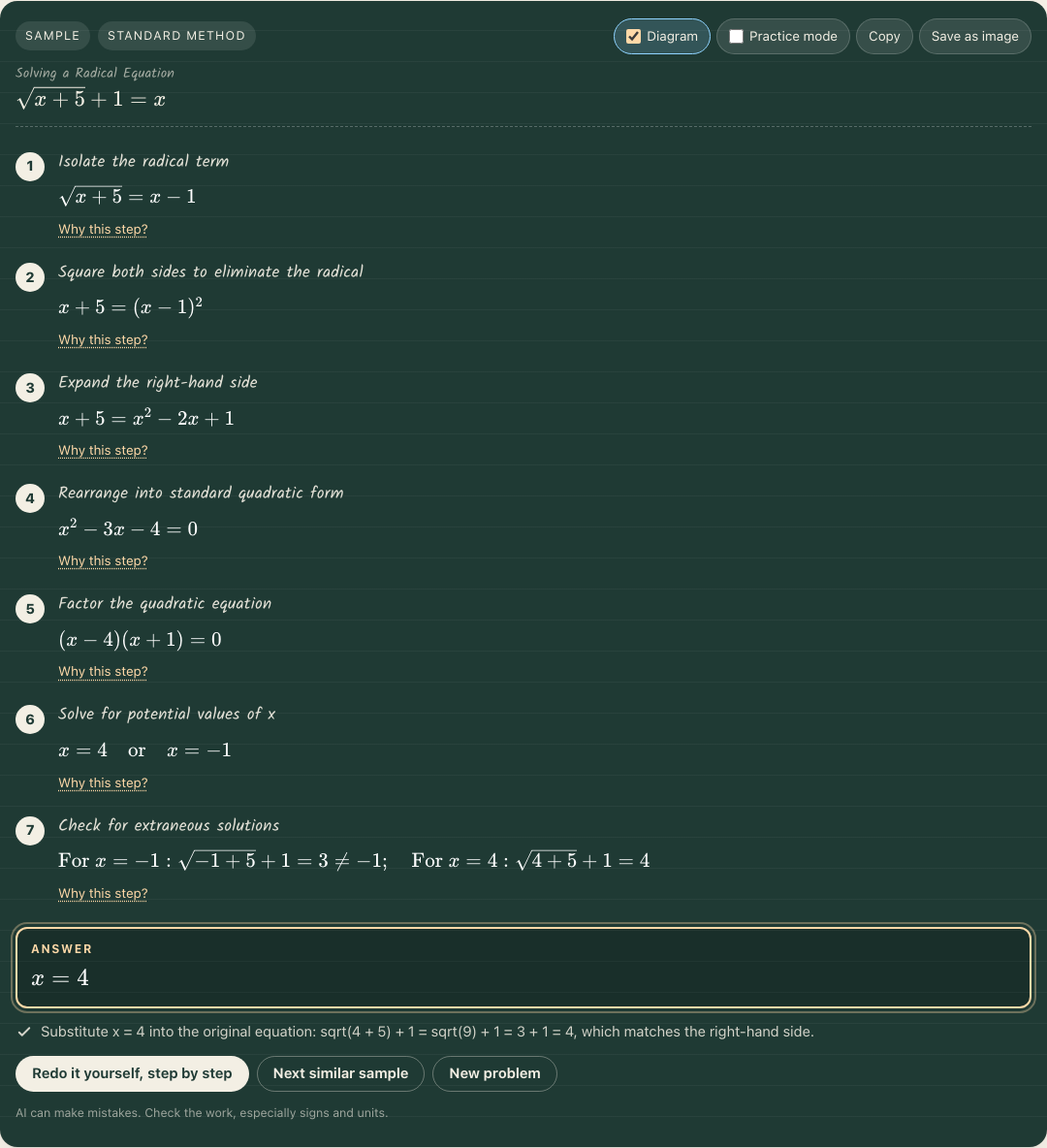
Isolate the radical termsqrt(x + 5) = x - 1Subtract 1 from both sides to isolate the square root expression on one side. A square root is never negative, so any answer must satisfy x − 1 ≥ 0, that is x ≥ 1 (and x + 5 ≥ 0).
Square both sides to eliminate the radicalx + 5 = (x - 1)^2Squaring both sides removes the radical, keeping in mind that we must check for extraneous solutions later.
Expand the right-hand sidex + 5 = x^2 - 2x + 1Expand the squared binomial using the identity (a - b)^2 = a^2 - 2ab + b^2.
Rearrange into standard quadratic formx^2 - 3x - 4 = 0Subtract x and 5 from both sides to set the quadratic equation equal to zero.
Factor the quadratic equation(x - 4)(x + 1) = 0Find two numbers that multiply to -4 and add to -3, which are -4 and 1.
Solve for potential values of xx = 4 or x = -1Apply the zero-product property by setting each factor equal to zero.
Check for extraneous solutionsFor x = -1: sqrt(-1 + 5) + 1 = 3 != -1; For x = 4: sqrt(4 + 5) + 1 = 4Substitute both values back into the original equation. x = -1 is extraneous, leaving x = 4 as the only valid solution.
Answer:x = 4
Check: Substitute x = 4 into the original equation: sqrt(4 + 5) + 1 = sqrt(9) + 1 = 3 + 1 = 4, which matches the right-hand side.
Isolate one of the square root termssqrt(x + 7) = 1 + sqrt(x)Add sqrt(x) to both sides to make squaring easier. Both roots need x ≥ 0, so any answer must be at least 0.
Square both sides of the equation(sqrt(x + 7))^2 = (1 + sqrt(x))^2Eliminate the radical on the left side by squaring both sides.
Expand both sidesx + 7 = 1 + 2*sqrt(x) + xApply the binomial expansion formula (a + b)^2 = a^2 + 2ab + b^2 to the right side.
Subtract x from both sides7 = 1 + 2*sqrt(x)Cancel the common term x on both sides to simplify.
Isolate the remaining square root term2*sqrt(x) = 6 => sqrt(x) = 3Subtract 1 from both sides, then divide by 2.
Square both sides to solve for xx = 3^2 = 9Square both sides once more to isolate x.
Answer:x = 9
Check: Substitute x = 9 back into the original equation: sqrt(9 + 7) - sqrt(9) = sqrt(16) - 3 = 4 - 3 = 1, which confirms the solution is correct and not extraneous.
Squaring before the root is alone, which leaves a root behind.
Squaring the two terms of a sum separately: (1 + sqrt(x))² is 1 + 2 sqrt(x) + x, not 1 + x.
If the squared equation is a quadratic, the factoring solver shows how to split it. For other equations, see solve for x.
Use it to learn the method. Try the problem on paper first, then compare your lines with the steps. The first line where you differ is the thing to practise. Solutions are written by an AI model and can contain mistakes, so keep the check line in the habit.
FAQ
How do you solve a radical equation?
Isolate the square root, square both sides, solve the new equation, and check every answer in the original equation. Reject any answer that does not satisfy it.
What is an extra (extraneous) solution?
An answer produced by squaring that does not satisfy the original equation. In sqrt(x + 6) = x, the value x = −2 appears after squaring but fails the check.
Can it solve an equation with two square roots?
Yes. The last example does one: it isolates one root, squares, isolates the remaining root, and squares again.
Is it free?
Yes. You get 3 full solutions a day with no account.