Draw it, then read the steps
Math solver number line: graph an inequality or a sum
This math solver number line draws your problem for you. Type an inequality such as 2x + 3 > 7, a range such as −3 < x ≤ 5, an absolute value such as |x − 2| < 3, or a sum such as −4 + 7. You get the number line with open or closed circles and the shaded direction, the answer in interval notation, and every step in words. The default example is drawn below. It runs in your browser and never uses a free solve.
Answer (2, ∞)
- Start2x + 3 > 7
- Move the numbers to the rightSubtract 3 from both sides: 2x > 4
- Divide by 2x > 2
- Interval notationx > 2 = (2, ∞)
- On the number lineDraw an open circle at 2 (that value is not included). Shade toward the arrow to show every number that works.
Check. Putting x = 3 into the original gives 9 > 7, which is true, so it belongs to the answer. At the boundary x = 2 it gives 7 > 7, which is false, so the circle is open.
Number line solver: what you can type
The solver reads the way you would write the problem on paper. These forms work:
- A linear inequality with one letter: 2x + 3 > 7, 3x − 1 <= 2x + 4, −2x >= 6, 2(x − 1) > x + 3.
- A range written as a chain: −3 < x <= 5 or −1 <= 2x + 3 < 9.
- Two conditions joined with a word: x < −2 or x >= 3 for the union, or x > 1 and x <= 4 for the overlap.
- An absolute value compared with a number: |x − 2| < 3 or |2x − 1| >= 5.
- A sum or difference of numbers: −4 + 7, 3 − 8, 3 − (−2).
How to use the math solver number line
- Type the problem in the box, or press one of the example buttons. Use <= and >= or the ≤ and ≥ keys under the box.
- Press Draw number line. The line, the interval notation and the steps appear below.
- Read the circles first: an open circle means the end value is not included, a filled circle means it is.
- Check the answer with the test value in the last line, then compare the picture with your own drawing.
If it cannot read your input, such as a square or two different letters, it says so instead of drawing a guess.
Inequality on a number line: open circle, filled circle, shading
Take 2x + 3 > 7. Subtract 3 to get 2x > 4, then divide by 2 to get x > 2. On the number line the boundary is at 2. Because the sign is > and not ≥, the number 2 itself does not work: 2(2) + 3 = 7, and 7 is not greater than 7. So the circle at 2 is open. Every number to the right of 2 works, so the line is shaded to the right and ends in an arrow, because the solutions never stop. In interval notation this is (2, ∞), and infinity always gets a round bracket.
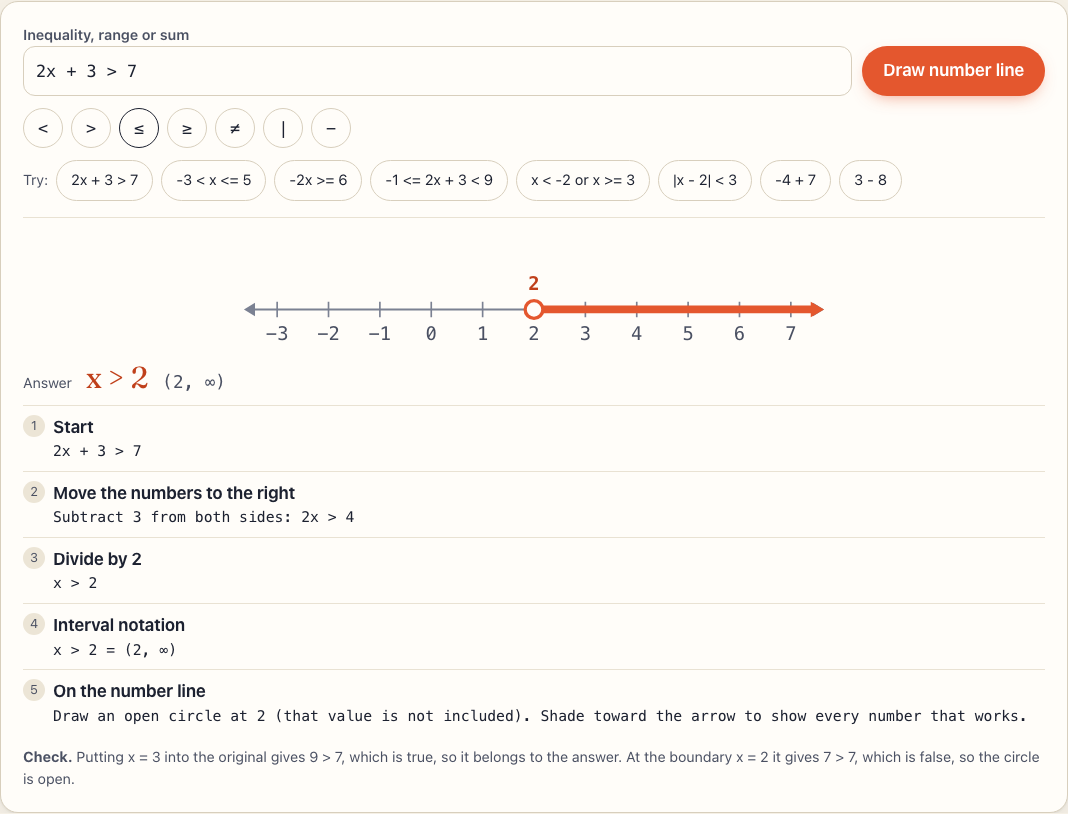
The rule for the two kinds of circle is short. An open circle goes with < or > and a round bracket. A filled circle goes with ≤ or ≥ and a square bracket. The Check line tests the boundary value, so you see the reason for the circle.
When the sign flips
Dividing or multiplying by a negative number reverses the sign. For −2x ≥ 6, dividing both sides by −2 gives x ≤ −3, and the shading runs to the left. The steps say "the sign turned around because −2 is negative" at that point. Check: −2(−4) = 8, and 8 ≥ 6 is true, while 0 gives 0 ≥ 6, which is false.
Compound inequalities on a number line
A chain such as −1 ≤ 2x + 3 < 9 is solved by doing the same thing to all three parts. Subtract 3 from each part: −4 ≤ 2x < 6. Divide each by 2: −2 ≤ x < 3. On the line there are now two circles: filled at −2 and open at 3, with the stretch between them shaded. The interval notation is [−2, 3). If you divide by a negative number, every sign reverses, and it is easiest to read the result from right to left so that the smaller number comes first.
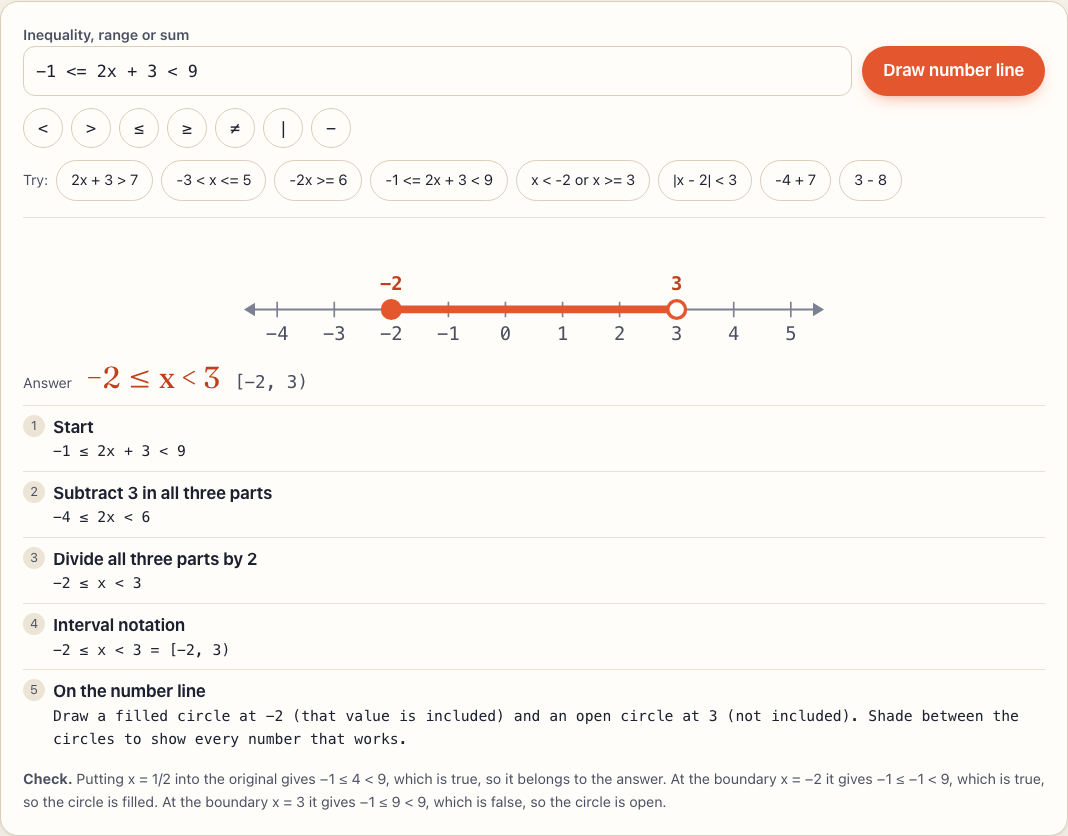
Two conditions joined with "or" give a union, which can be two separate shaded pieces. For x < −2 or x ≥ 3, one piece runs left from an open circle at −2 and the other runs right from a filled circle at 3, so the interval notation is (−∞, −2) ∪ [3, ∞). "And" works the other way: it keeps only the numbers that satisfy both conditions, so the shaded part is where the two pictures overlap, and it can be empty.
Absolute value on a number line
The absolute value |x − 2| is the distance from x to 2. So |x − 2| < 3 means x is less than 3 units from 2, which is the stretch from −1 to 5 with open circles at both ends: (−1, 5). For |x − 2| > 3, x is below −1 or above 5. The solver rewrites the bars first, then solves. If the number on the right is negative, it points out that an absolute value is never negative: |x| < −2 has no solution, while |x| > −2 is true for every number.
Number line calculator for adding and subtracting integers
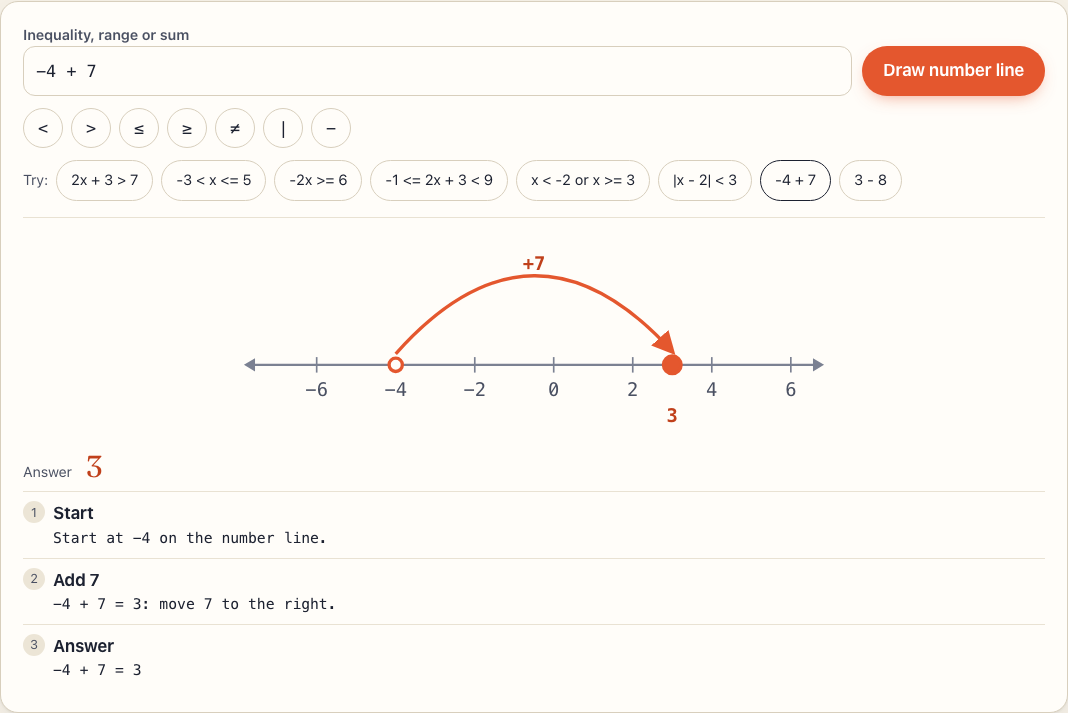
The same box draws sums. For −4 + 7 the line starts at −4 and an arc moves 7 units to the right, landing on 3. For 3 − 8 the arc moves 8 units left from 3 and lands on −5. Subtracting a negative number moves the other way: 3 − (−2) lands on 5, because subtracting −2 is the same as adding 2. Each arc is labelled with its move.
Check your number line in three steps
- Say the picture aloud: "all numbers greater than 2, not including 2". If that is not the sentence you meant, fix the circle or the direction.
- Test one number from the shaded part in the original inequality. It must make the statement true.
- Test the boundary value. If it makes the statement true, the circle is filled; if false, the circle is open.
The line marked Check does the second and third steps for you, with the actual numbers.
What this number line solver does not draw
It handles one variable and linear expressions. It does not draw quadratics such as x² − 5x + 6 < 0, rational inequalities with x in a denominator, or two-variable regions. For quadratic and other worked examples with full steps, use the inequalities math solver, which also shows number lines for its interval answers, or the algebra solver for equations and systems.
FAQ
What can I type into the number line solver?
One-variable linear inequalities such as 2x + 3 > 7 or 3x − 1 ≤ 2x + 4, ranges such as −3 < x ≤ 5, two conditions joined with "or" or "and", absolute value comparisons such as |x − 2| < 3, and sums or differences such as −4 + 7 or 3 − (−2).
When is the circle open and when is it filled?
It is open for < and >, because the end value does not make the statement true. It is filled for ≤ and ≥, because the end value does. The last line of each solution tests the boundary so you can see which case applies.
Why does the inequality sign flip when I divide by a negative number?
Multiplying or dividing by a negative number reverses the order of numbers. For example 2 < 5 becomes −2 > −5 after multiplying both sides by −1. The solver writes the flip as part of the step and says why.
Can it graph a quadratic inequality such as x² − 5x + 6 < 0?
Not on this page, because it handles linear pieces only and says so if you type a power. The inequalities math solver on this site works through quadratic examples step by step and draws their intervals.
Is my input sent anywhere?
No. The drawing and the steps are calculated by JavaScript on this page. Nothing is uploaded and it does not count against the free daily solves.