Matrix math solver and matrix calculator with steps
This matrix math solver answers matrix homework and shows the working: the inverse of a matrix, a determinant, a product of two matrices, or a linear system solved on an augmented matrix. Type the matrix in rows, such as [[4, 7], [2, 6]], or photograph the page.
photo
We read the problem from the picture.
or type it
Free: 3 problems a day. Sample problems never count.
Recent
Try a sample
TypedStandard method
Answer
AI can make mistakes. Check the work, especially signs and units.
We read:Wrong? Edit the text box and solve again.
You've used today's 3 free solves
Come back tomorrow, or go unlimited with Plus: every step explained, another method on demand, save solutions as images.
What a matrix calculator with steps does differently
An ordinary matrix calculator prints a grid of numbers and stops. A matrix calculator with steps writes out each move with a one-line reason, the way a worked example in a textbook does, so you can find the line where your own work went wrong. The four examples below are real output for a 2×2 inverse, a 3×3 determinant, a matrix product and a linear system. Other operations, such as a transpose or eigenvalues, are not shown here; you can type them, and if the solver cannot do a problem it says so and the attempt does not use a free solve.
How to use it
Type the matrix with one pair of square brackets per row inside an outer pair, for example [[1, 2], [3, 4]].
Say what you want: find the inverse of, find the determinant of, multiply, or solve the system using a matrix.
For a linear system, type the equations separated by commas, such as 2x + y = 7, x - 3y = -7.
Read the steps, and fix any misread entry in the box.
Matrix math solver: worked examples with steps
Each example is the solver's own output, and each final answer was checked separately with a computer algebra system. Use the link under an example to run it on the board above.
1. Find the inverse of the matrix [[4, 7], [2, 6]]
Identify the matrix elementsA = [[a, b], [c, d]] = [[4, 7], [2, 6]]Assign variable labels to each element of the 2x2 matrix.
Calculate the determinantdet(A) = ad - bc = (4)(6) - (7)(2) = 24 - 14 = 10The determinant of a 2x2 matrix is computed using ad - bc. Since the determinant is non-zero, the matrix is invertible.
Set up the adjugate matrixadj(A) = [[d, -b], [-c, a]] = [[6, -7], [-2, 4]]Swap the diagonal elements and negate the off-diagonal elements to form the adjugate matrix.
Multiply by the reciprocal of the determinantA^(-1) = (1/10) * [[6, -7], [-2, 4]] = [[3/5, -7/10], [-1/5, 2/5]]Multiply each entry in the adjugate matrix by 1 over the determinant and simplify fractions.
Answer:[[3/5, -7/10], [-1/5, 2/5]]
Check: Multiply A by A^{-1}: [[4, 7], [2, 6]] * [[0.6, -0.7], [-0.2, 0.4]] = [[4(0.6)+7(-0.2), 4(-0.7)+7(0.4)], [2(0.6)+6(-0.2), 2(-0.7)+6(0.4)]] = [[2.4-1.4, -2.8+2.8], [1.2-1.2, -1.4+2.4]] = [[1, 0], [0, 1]], which yields the identity matrix.
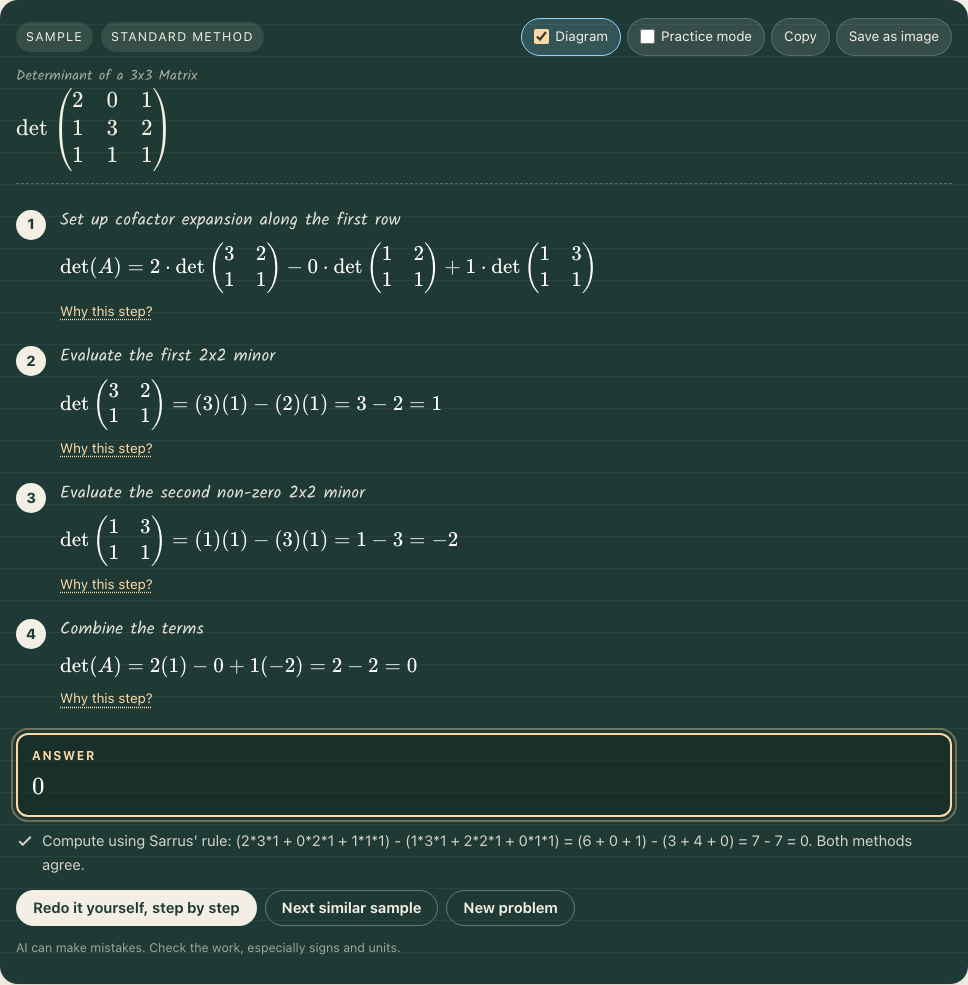
2. Find the determinant of the 3x3 matrix [[2, 0, 1], [1, 3, 2], [1, 1, 1]]
Set up cofactor expansion along the first rowdet(A) = 2 * det([[3, 2], [1, 1]]) - 0 * det([[1, 2], [1, 1]]) + 1 * det([[1, 3], [1, 1]])Expanding along the first row takes advantage of the zero entry to simplify calculations.
Evaluate the first 2x2 minordet([[3, 2], [1, 1]]) = 3*1 - 2*1 = 1Use the formula ad - bc for the determinant of a 2x2 matrix.
Evaluate the second non-zero 2x2 minordet([[1, 3], [1, 1]]) = 1*1 - 3*1 = -2Apply the 2x2 determinant formula to the minor corresponding to the entry in row 1, column 3.
Combine the termsdet(A) = 2*(1) - 0 + 1*(-2) = 0Multiply each minor by its corresponding cofactor and sum the results.
3. Multiply the matrices [[1, 2], [3, 4]] and [[5, 6], [7, 8]]
Set up the product matrix[[1, 2], [3, 4]] * [[5, 6], [7, 8]] = [[c11, c12], [c21, c22]]Multiplying two 2x2 matrices produces another 2x2 matrix where each entry is the dot product of a row from the first matrix and a column from the second.
Calculate the entry in row 1, column 1c11 = (1)(5) + (2)(7) = 5 + 14 = 19Take the dot product of the first row of the left matrix and the first column of the right matrix.
Calculate the entry in row 1, column 2c12 = (1)(6) + (2)(8) = 6 + 16 = 22Take the dot product of the first row of the left matrix and the second column of the right matrix.
Calculate the entry in row 2, column 1c21 = (3)(5) + (4)(7) = 15 + 28 = 43Take the dot product of the second row of the left matrix and the first column of the right matrix.
Calculate the entry in row 2, column 2c22 = (3)(6) + (4)(8) = 18 + 32 = 50Take the dot product of the second row of the left matrix and the second column of the right matrix.
Assemble the final product matrix[[19, 22], [43, 50]]Combine all computed entries into the resulting 2x2 matrix.
Answer:[[19, 22], [43, 50]]
Check: Compute the determinant property: det(A) = 1(4) - 2(3) = -2, det(B) = 5(8) - 6(7) = -2. The product determinant should be det(A)det(B) = (-2)(-2) = 4. For the result: 19(50) - 22(43) = 950 - 946 = 4, which matches det(AB) = det(A)det(B).
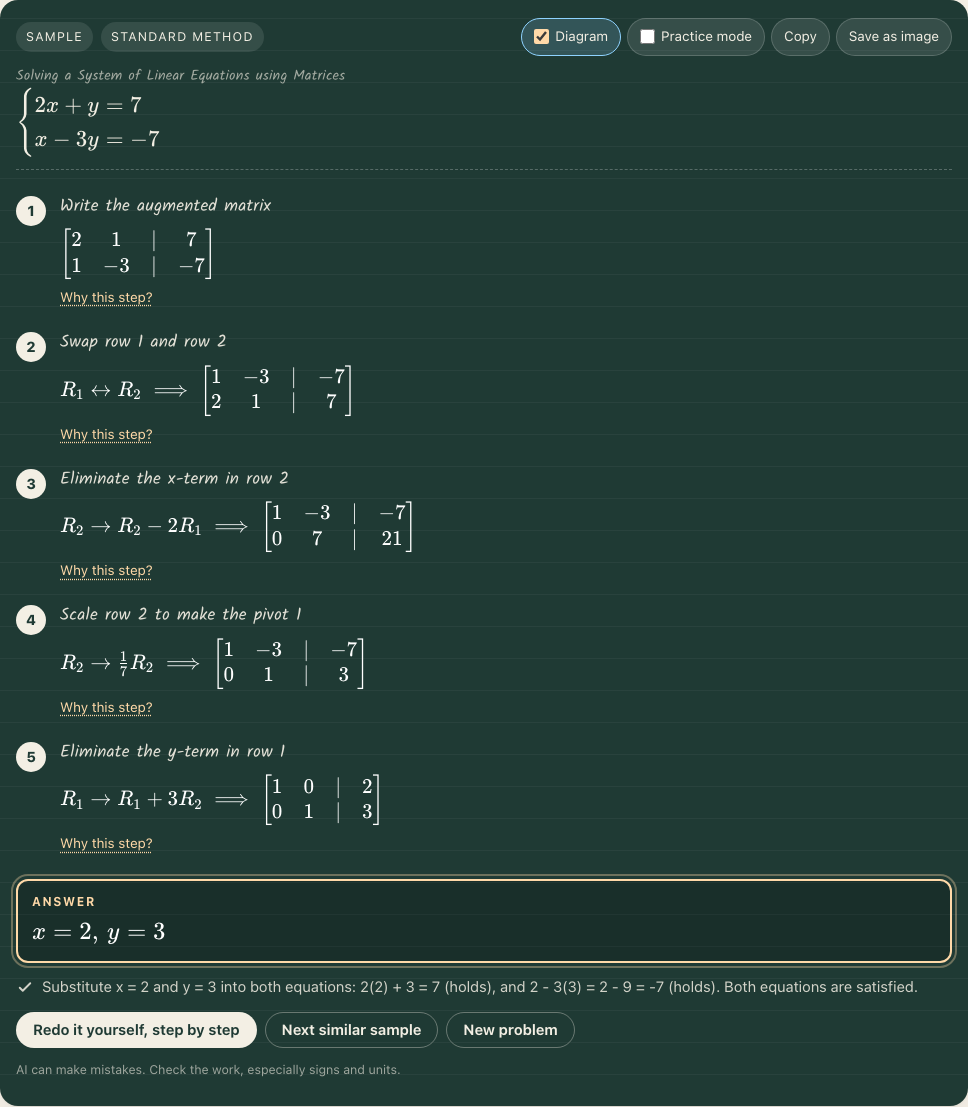
4. Solve the system using a matrix: 2x + y = 7, x - 3y = -7
Write the augmented matrix[ [2, 1 | 7], [1, -3 | -7] ]Represent the coefficients and constants of the linear system in an augmented matrix form.
Swap row 1 and row 2Swap R1 and R2: [ [1, -3 | -7], [2, 1 | 7] ]Placing a 1 in the top-left pivot position simplifies subsequent row operations.
Eliminate the x-term in row 2R2 -> R2 - 2*R1: [ [1, -3 | -7], [0, 7 | 21] ]Subtract 2 times the first row from the second row to create a zero in the first column.
Scale row 2 to make the pivot 1R2 -> (1/7)*R2: [ [1, -3 | -7], [0, 1 | 3] ]Divide row 2 by 7 to solve directly for y.
Eliminate the y-term in row 1R1 -> R1 + 3*R2: [ [1, 0 | 2], [0, 1 | 3] ]Add 3 times the second row to the first row to obtain reduced row echelon form (RREF).
Answer:x = 2, y = 3
Check: Substitute x = 2 and y = 3 into both equations: 2(2) + 3 = 7 (holds), and 2 - 3(3) = 2 - 9 = -7 (holds). Both equations are satisfied.
For a matrix with rows (a, b) and (c, d), compute the determinant ad − bc first. If it is zero the matrix has no inverse. Otherwise swap a and d, change the signs of b and c, and divide every entry by the determinant. Multiplying the original matrix by your answer should give the identity matrix, which is the check the solver writes in its last line.
When the determinant is zero
The second example has determinant 0, so its rows are linearly dependent and the matrix has no inverse. Expanding along a row that contains a zero, as the solver does there, saves work.
Use it to learn the method. Try the problem on paper first, then compare your lines with the steps. The first line where you differ is the thing to practise. Solutions are written by an AI model and can contain mistakes, so keep the check line in the habit.
FAQ
Is this matrix calculator with steps free?
Yes. You get 3 full step-by-step solutions a day with no account. The worked examples on this page, opened with the links under them, never count against that.
Which matrix problems has it been tested on?
The four shown here: a 2×2 inverse, a 3×3 determinant, a 2×2 product and a two-variable system. Larger matrices may work but are untested here, so check the result by multiplying back.
Can it read a matrix from a photo?
Yes, from a printed or neat handwritten page. The text it read is shown above the working so you can correct it.