Linear algebra solver: a linear algebra system of equations solver with steps
This linear algebra solver, a linear algebra system of equations solver, writes the augmented matrix and row reduces it one operation at a time, then reads off the rank: one solution, none, or infinitely many. Type the equations or take a photo.
photo
We read the problem from the picture.
or type it
Free: 3 problems a day. Sample problems never count.
Recent
Try a sample
TypedStandard method
Answer
AI can make mistakes. Check the work, especially signs and units.
We read:Wrong? Edit the text box and solve again.
You've used today's 3 free solves
Come back tomorrow, or go unlimited with Plus: every step explained, another method on demand, save solutions as images.
What a linear algebra system of equations solver does
A system of linear equations asks for numbers that satisfy several equations at once. In linear algebra it is stored as an augmented matrix: one row per equation, one column per variable, and a last column for the constants. Row operations (swap, scale, add a multiple of one row to another) never change the solutions. Each is listed with its reason.
Rank decides how many solutions there are
The rank is the number of pivots left after row reduction. If the coefficient matrix has a smaller rank than the augmented matrix, some row has become 0 = 1 and there is no solution. If the ranks are equal and match the number of unknowns, there is exactly one solution. If they are equal but smaller, there are infinitely many, with (unknowns minus rank) free variables. For inverses and determinants see the matrix math solver; for two equations, the algebra elimination solver.
How to use it
Type the equations separated by commas, for example x + 2y + z = 4, 2x + 5y + 2z = 9.
Read each row operation and its reason.
Read the last lines: the rank, then the answer, no solution, or a free variable.
Linear algebra solver: worked examples with row reduction
Worked by hand in the format the solver uses, each answer checked by substitution: one solution, none, and infinitely many.
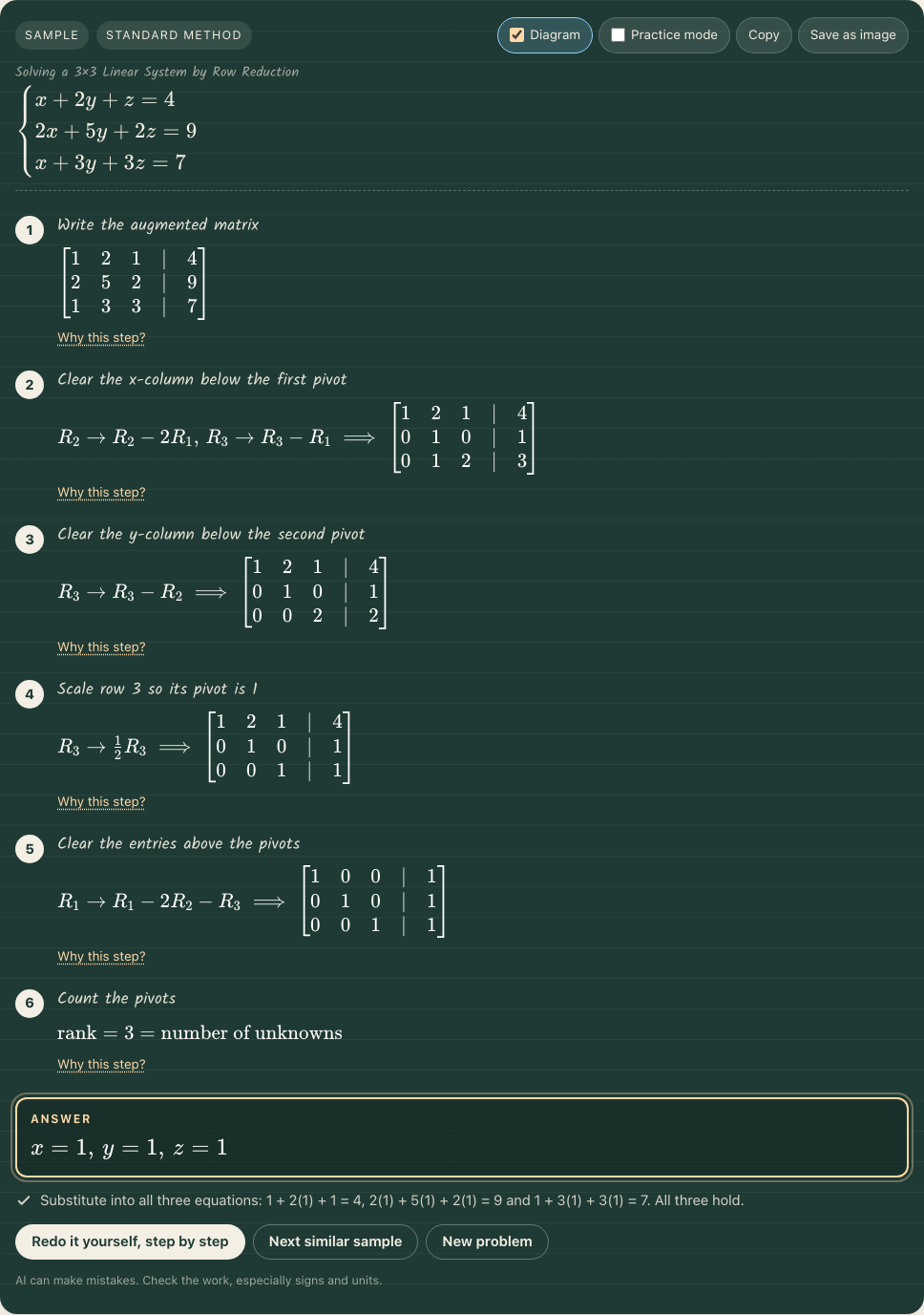
1. Solve the system using row reduction: x + 2y + z = 4, 2x + 5y + 2z = 9, x + 3y + 3z = 7
Write the augmented matrix[ [1, 2, 1 | 4], [2, 5, 2 | 9], [1, 3, 3 | 7] ]Each row holds the coefficients of x, y, z and then the constant, so the three equations become one matrix.
Clear the x-column below the first pivotR2 -> R2 - 2*R1, R3 -> R3 - R1: [ [1, 2, 1 | 4], [0, 1, 0 | 1], [0, 1, 2 | 3] ]The pivot in row 1 is 1, so subtracting multiples of it from the rows below puts zeros under it.
Clear the y-column below the second pivotR3 -> R3 - R2: [ [1, 2, 1 | 4], [0, 1, 0 | 1], [0, 0, 2 | 2] ]Row 2 now has a leading 1 in the y-column, so subtracting it from row 3 removes the y-term there.
Scale row 3 so its pivot is 1R3 -> (1/2)*R3: [ [1, 2, 1 | 4], [0, 1, 0 | 1], [0, 0, 1 | 1] ]Dividing the row by 2 gives a leading 1, which reads off z = 1 directly.
Clear the entries above the pivotsR1 -> R1 - 2*R2 - R3: [ [1, 0, 0 | 1], [0, 1, 0 | 1], [0, 0, 1 | 1] ]Subtracting 2 times row 2 and 1 times row 3 from row 1 leaves only the x-term, which finishes the reduced row echelon form.
Answer:x = 1, y = 1, z = 1
Check: Substitute into all three equations: 1 + 2(1) + 1 = 4, 2(1) + 5(1) + 2(1) = 9 and 1 + 3(1) + 3(1) = 7. All three hold.
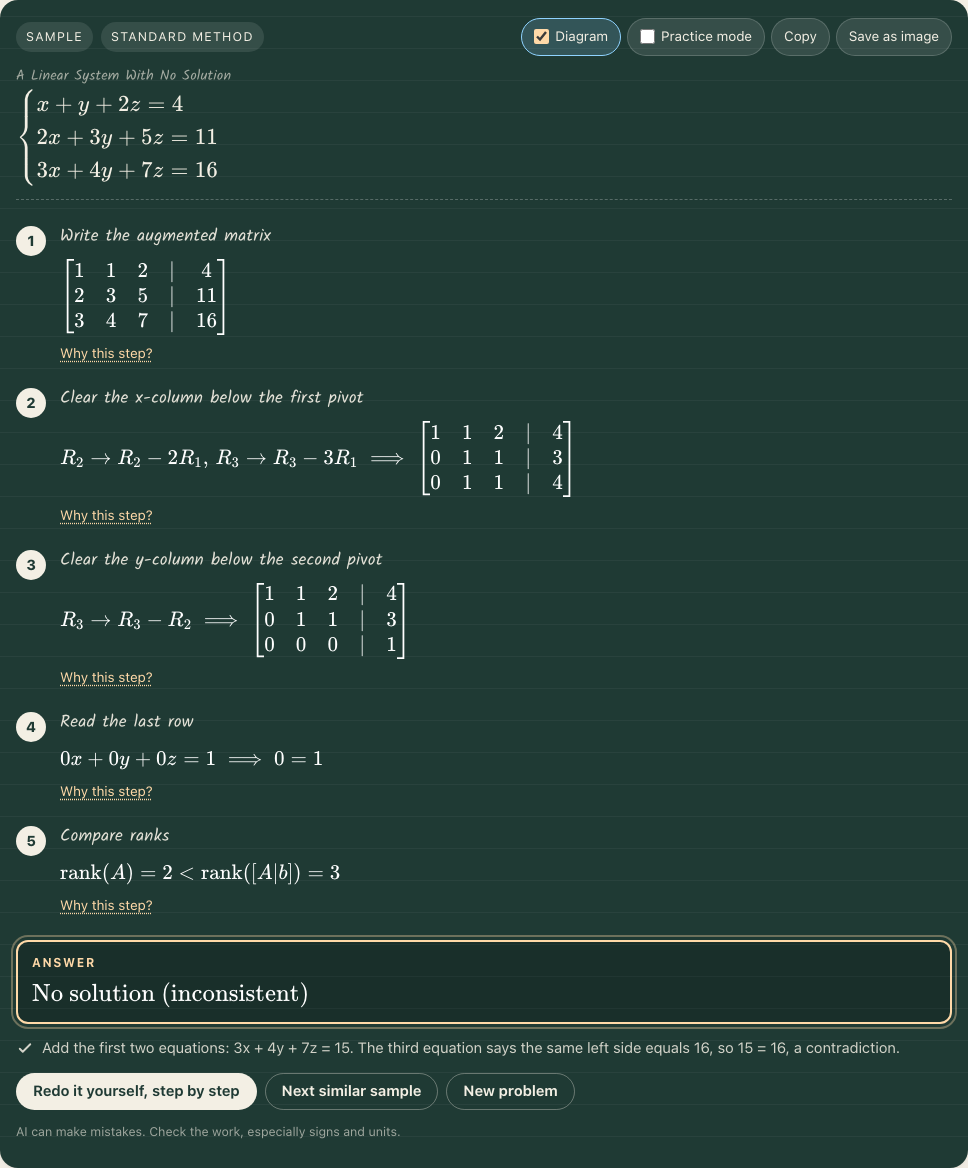
2. Solve the system: x + y + 2z = 4, 2x + 3y + 5z = 11, 3x + 4y + 7z = 16
Write the augmented matrix[ [1, 1, 2 | 4], [2, 3, 5 | 11], [3, 4, 7 | 16] ]The coefficients go left of the bar and the constants right of it.
Clear the x-column below the first pivotR2 -> R2 - 2*R1, R3 -> R3 - 3*R1: [ [1, 1, 2 | 4], [0, 1, 1 | 3], [0, 1, 1 | 4] ]Subtract 2 times row 1 from row 2 and 3 times row 1 from row 3.
Clear the y-column below the second pivotR3 -> R3 - R2: [ [1, 1, 2 | 4], [0, 1, 1 | 3], [0, 0, 0 | 1] ]Rows 2 and 3 have the same coefficients, so subtracting leaves a row of zeros on the left.
Read the last row0x + 0y + 0z = 1, so 0 = 1The last row says zero equals one, which is false for every x, y and z, so the system is inconsistent.
Answer:No solution (inconsistent)
Check: Add the first two equations: 3x + 4y + 7z = 15. The third equation says the same left side equals 16, so 15 = 16, a contradiction.
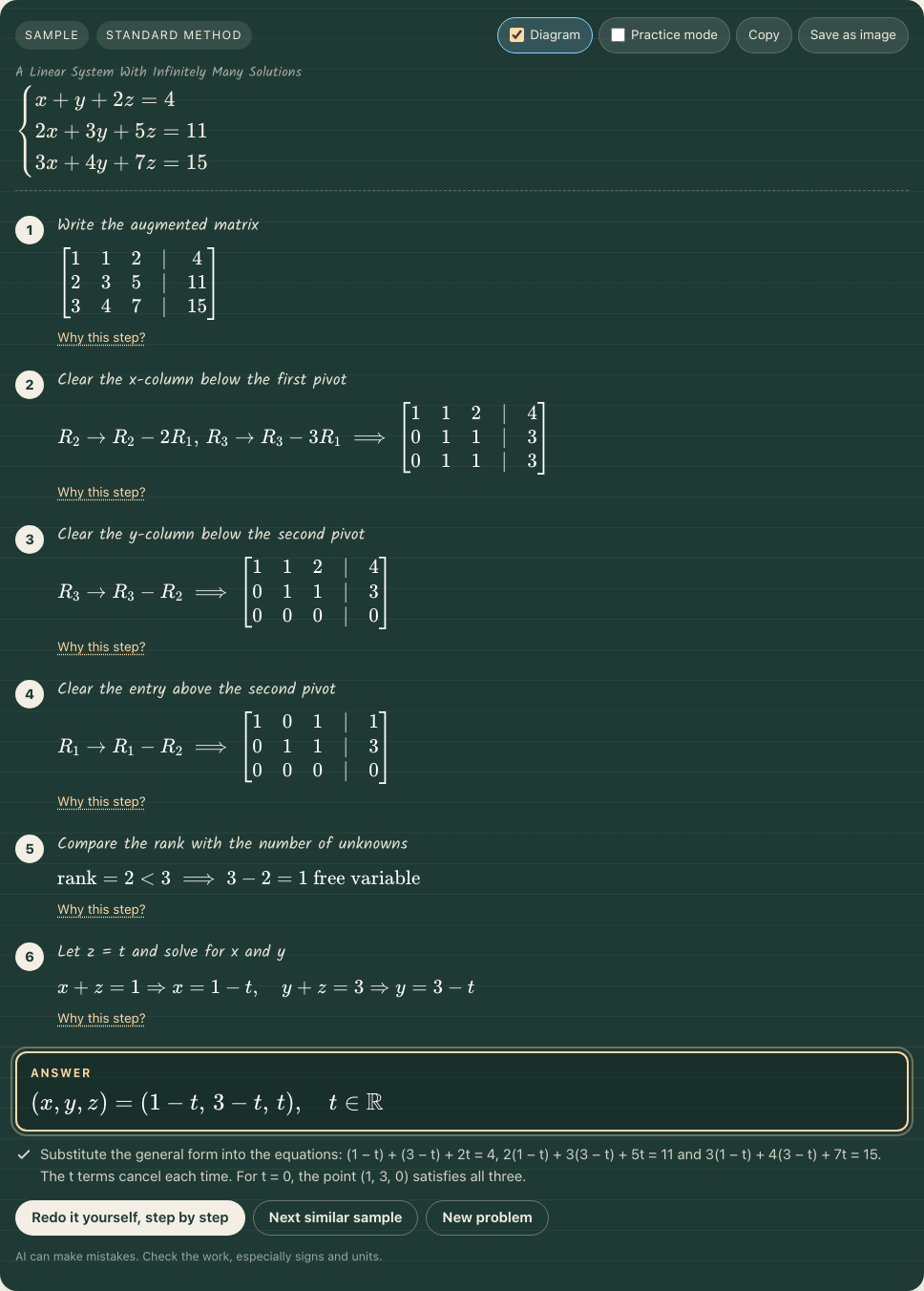
3. Solve the system: x + y + 2z = 4, 2x + 3y + 5z = 11, 3x + 4y + 7z = 15
Write the augmented matrix[ [1, 1, 2 | 4], [2, 3, 5 | 11], [3, 4, 7 | 15] ]Same coefficients as the previous example, but the last constant is 15 instead of 16.
Clear the x-column below the first pivotR2 -> R2 - 2*R1, R3 -> R3 - 3*R1: [ [1, 1, 2 | 4], [0, 1, 1 | 3], [0, 1, 1 | 3] ]Subtract 2 times row 1 from row 2 and 3 times row 1 from row 3.
Clear the y-column below the second pivotR3 -> R3 - R2: [ [1, 1, 2 | 4], [0, 1, 1 | 3], [0, 0, 0 | 0] ]Rows 2 and 3 are now identical, so row 3 becomes all zeros.
Clear the entry above the second pivotR1 -> R1 - R2: [ [1, 0, 1 | 1], [0, 1, 1 | 3], [0, 0, 0 | 0] ]This gives the reduced row echelon form.
Compare the rank with the number of unknownsrank = 2 < 3, so 1 free variableThe system is consistent and has fewer pivots than unknowns, so there are infinitely many solutions.
Answer:(x, y, z) = (1 - t, 3 - t, t), t any real number
Check: Substitute the general form into the equations: (1 − t) + (3 − t) + 2t = 4, 2(1 − t) + 3(3 − t) + 5t = 11 and 3(1 − t) + 4(3 − t) + 7t = 15. The t terms cancel each time. For t = 0, the point (1, 3, 0) satisfies all three.
Reading a zero row as a free variable. A row 0 0 0 | 0 only means one equation was redundant. Count pivots against unknowns; a row 0 0 0 | c with c not zero means no solution.
Use it to learn the method. Try the problem on paper first, then compare your lines with the steps. The first line where you differ is the thing to practise. Solutions are written by an AI model and can contain mistakes, so keep the check line in the habit.
FAQ
What is a linear algebra system of equations solver?
It solves several linear equations at once by row reducing the augmented matrix, and shows each operation, the rank and the solution set.
How can I tell if a system has no solution or infinitely many?
Row reduce. A row 0 … 0 | c with c not zero (such as 0 = 1) means no solution. Otherwise it is consistent: rank equal to the unknowns gives a unique solution, smaller rank gives free variables and infinitely many. Example: x = 1, y = 2, x + y = 3 has a zero row but one solution.