Inequalities math solver and algebra inequalities solver
Solve an inequality and get the answer as an interval, with every step shown. This inequalities math solver reverses the sign when you divide by a negative, turns absolute values into compound inequalities, and tests points to check the result. Type it or take a photo.
photo
We read the problem from the picture.
or type it
Free: 3 problems a day. Sample problems never count.
Recent
Try a sample
TypedStandard method
Answer
AI can make mistakes. Check the work, especially signs and units.
We read:Wrong? Edit the text box and solve again.
You've used today's 3 free solves
Come back tomorrow, or go unlimited with Plus: every step explained, another method on demand, save solutions as images.
Solving an inequality is solving an equation with one extra rule. You may add or subtract the same number on both sides, and multiply or divide by a positive number, without changing anything. Multiply or divide by a negative number and the inequality sign must turn around. This algebra inequalities solver writes that flip as its own step, so you see the rule and not only the arithmetic.
The four worked examples cover the types that fill most homework: a linear inequality, a compound inequality, a quadratic inequality and an absolute value inequality. For other kinds, such as rational inequalities, you can type them too; if a problem is out of range the solver says so.
Interval notation and the number line
The same answer can be written three ways: as an inequality (2 < x < 3), in interval notation ((2, 3)), and as a shaded number line. A round bracket and an open circle both mean the end point is not included. A square bracket and a filled circle mean it is. Infinity always gets a round bracket. Each worked example below has a number line drawn for its answer. To draw your own inequality, range or sum, use the math solver number line.
How to use it
Type the inequality as written. Use <= and >= for ≤ and ≥, or the symbol keys under the box.
Add "write the answer in interval notation" if your teacher wants brackets instead of an inequality.
Read each step. The solver names the move and says why it is allowed, especially when the sign flips.
Check the answer with the test points in the last line, then compare with your own number line.
Inequalities math solver: worked examples with intervals
Each example is the solver's own output for the problem shown, and each final answer was checked separately with a computer algebra system. Tap the link under an example to run it on the board at the top of the page.
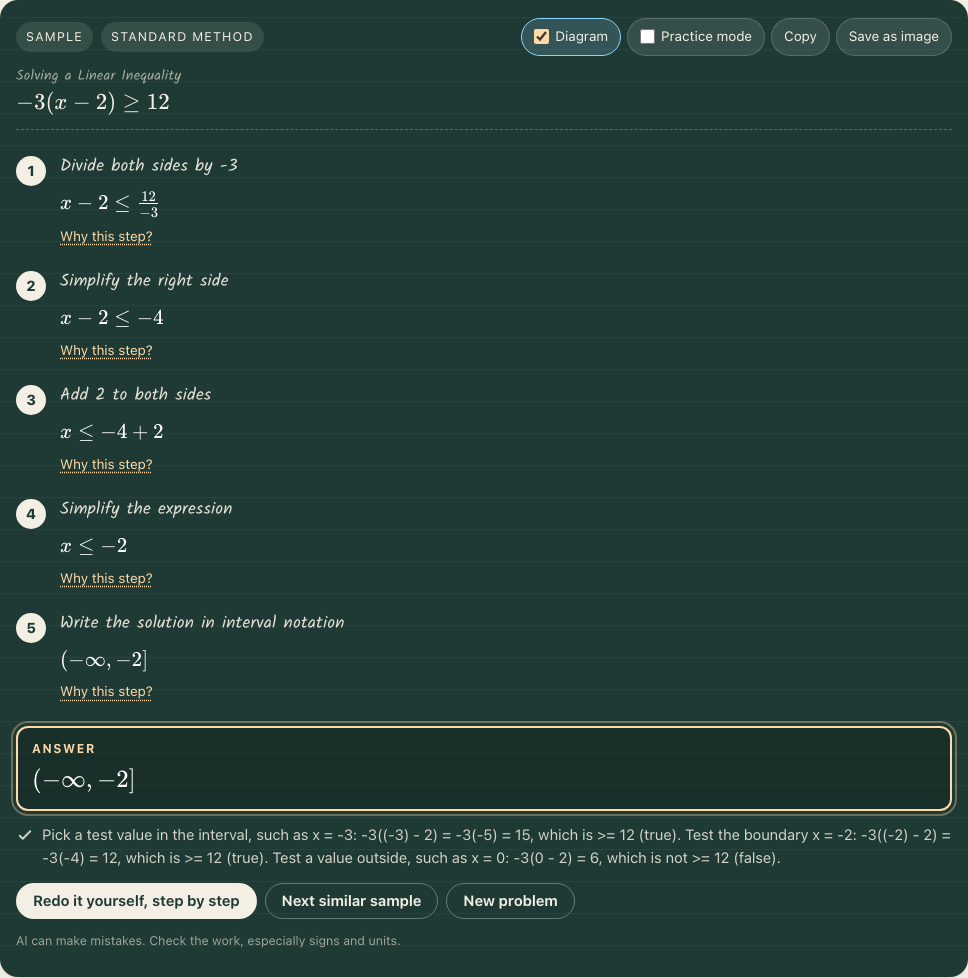
1. Solve -3(x - 2) >= 12 and write the answer in interval notation
Divide both sides by -3x - 2 <= 12 / (-3)Dividing both sides of an inequality by a negative number reverses the direction of the inequality sign.
Simplify the right sidex - 2 <= -4Evaluate 12 divided by -3 to get -4.
Add 2 to both sidesx <= -4 + 2Isolate the variable x by adding 2 to both sides.
Simplify the expressionx <= -2Calculate -4 + 2 to find the upper bound for x.
Write the solution in interval notation(-infinity, -2]All real numbers less than or equal to -2 are included, using a square bracket at -2 to indicate inclusion.
Answer:(-infinity, -2]
Check: Pick a test value in the interval, such as x = -3: -3((-3) - 2) = -3(-5) = 15, which is >= 12 (true). Test the boundary x = -2: -3((-2) - 2) = -3(-4) = 12, which is >= 12 (true). Test a value outside, such as x = 0: -3(0 - 2) = 6, which is not >= 12 (false).
Number line for the answer: x ≤ −2, which is (−∞, −2]
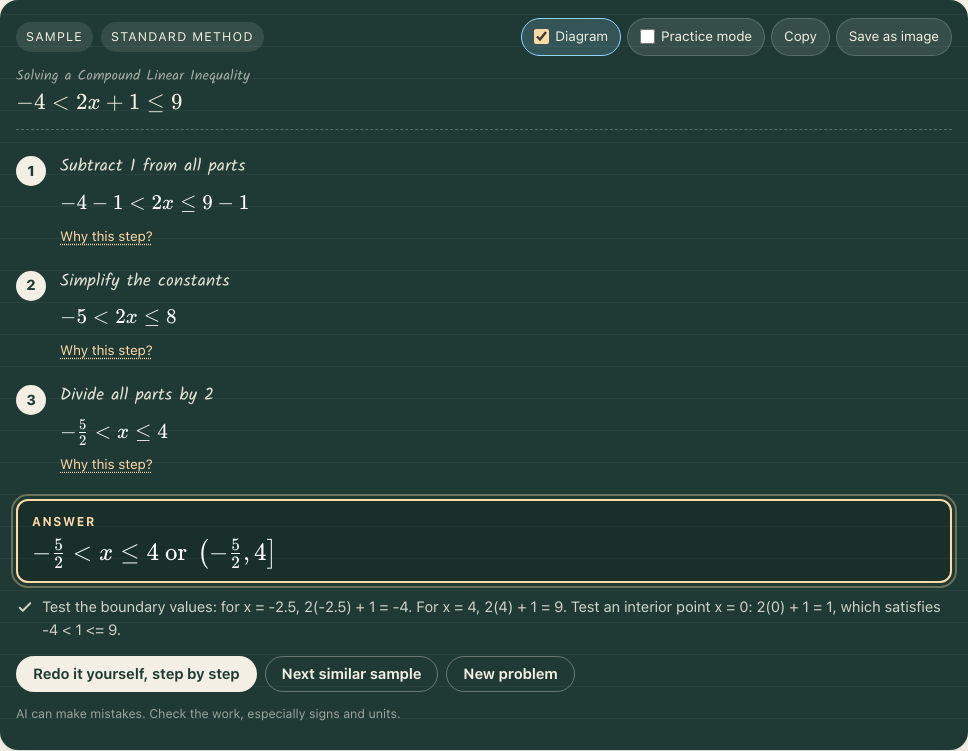
Subtract 1 from all parts-4 - 1 < 2x <= 9 - 1Subtract 1 from each section of the compound inequality to begin isolating the term with x.
Simplify the constants-5 < 2x <= 8Compute the differences on the left and right sides.
Divide all parts by 2-5/2 < x <= 4Divide each part by 2. Since 2 is positive, the inequality signs do not reverse.
Answer:-5/2 < x <= 4 or (-5/2, 4]
Check: Test the boundary values: for x = -2.5, 2(-2.5) + 1 = -4. For x = 4, 2(4) + 1 = 9. Test an interior point x = 0: 2(0) + 1 = 1, which satisfies -4 < 1 <= 9.
Number line for the answer: −5/2 < x ≤ 4, which is (−5/2, 4]
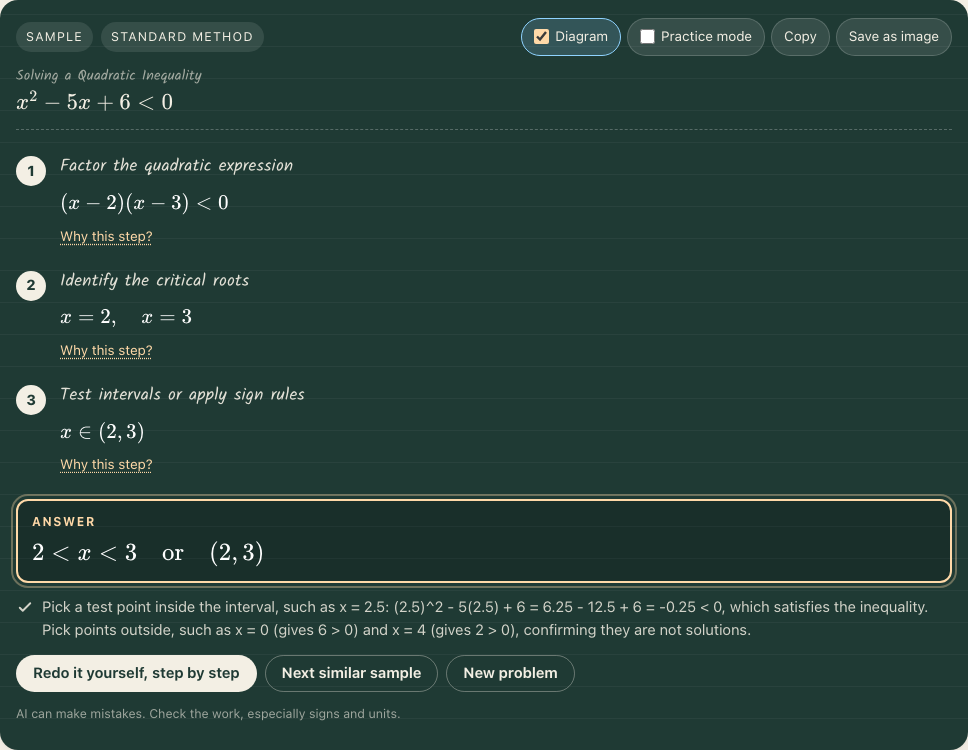
Factor the quadratic expression(x - 2)(x - 3) < 0Find two numbers that multiply to 6 and add to -5, which are -2 and -3.
Identify the critical rootsx = 2, x = 3Set each factor to zero to find the boundary points where the expression can change sign.
Test intervals or apply sign rules2 < x < 3The product of two factors is negative when one factor is positive and the other is negative, which occurs strictly between the roots 2 and 3.
Answer:2 < x < 3 or (2, 3)
Check: Pick a test point inside the interval, such as x = 2.5: (2.5)^2 - 5(2.5) + 6 = 6.25 - 12.5 + 6 = -0.25 < 0, which satisfies the inequality. Pick points outside, such as x = 0 (gives 6 > 0) and x = 4 (gives 2 > 0), confirming they are not solutions.
Number line for the answer: 2 < x < 3, which is (2, 3)
Flip the sign when you multiply or divide both sides by a negative number.
|expression| < k means the expression sits between −k and k. |expression| > k means it is below −k or above k.
For a quadratic inequality, find the roots first, then test one number from each region between them.
Check an inequality with test points
Pick one number inside your answer and one outside it, and put each into the original inequality. The inside number must make it true and the outside number must make it false. Then test each end point to see whether it belongs. This takes ten seconds and catches almost every sign error.
Use it to learn the method. Try the problem on paper first, then compare your lines with the steps. The first line where you differ is the thing to practise. Solutions are written by an AI model and can contain mistakes, so keep the check line in the habit.
FAQ
Does the solver give the answer in interval notation?
Yes. Ask for it in the problem ("write the answer in interval notation") or read it from the last line. Compound and absolute value answers are shown both as an inequality and as an interval.
Does it flip the inequality sign when dividing by a negative?
Yes, and it writes that as a separate step with the reason, so you can see exactly where the sign changed.
Can it solve a quadratic inequality?
Yes. The worked example factors x² − 5x + 6, finds the roots 2 and 3, and tests the regions between them to decide where the expression is negative.
How is this different from the algebra page?
The algebra solver covers equations, systems and inequalities together. This page is for inequalities only, so the examples, rules and answer formats here are all about intervals.
Is it free?
Yes, 3 full step-by-step solutions a day with no account. Opening an example from this page never uses one.