Algebra solver simplify: algebra expression solver with steps
Simplify an algebraic expression and see each step: expand brackets, combine like terms, cancel common factors and apply exponent rules. Type the expression or take a photo, and this algebra solver for simplifying writes the move and the reason for every line, then checks the result with a test value.
photo
We read the problem from the picture.
or type it
Free: 3 problems a day. Sample problems never count.
Recent
Try a sample
TypedStandard method
Answer
AI can make mistakes. Check the work, especially signs and units.
We read:Wrong? Edit the text box and solve again.
You've used today's 3 free solves
Come back tomorrow, or go unlimited with Plus: every step explained, another method on demand, save solutions as images.
An expression has no equals sign, so there is nothing to solve for. Simplifying means rewriting it in an equivalent form with fewer terms or a cleaner shape, for example 3(2x − 4) − 2(x + 5) becomes 4x − 22. The value stays the same for every x; only the way it is written changes. That is why the last line of each solution substitutes a number into the original and the result and checks that the two agree.
The algebra expression solver: four moves cover most problems
Expand brackets with the distributive property, taking care with a minus sign in front.
Combine like terms: terms with the same variable part, such as 6x and −2x.
Factor and cancel in a fraction. Only a common factor can be cancelled, never a common term.
Use exponent rules: multiply the powers inside a power, subtract the exponents when you divide.
How to use it
Type the expression, starting with the word simplify. Use ^ for powers, / for fractions and brackets for grouping.
Read the steps. Each one is a single move: expand, collect like terms, factor, cancel or use an exponent rule.
Compare the last line with yours. Equivalent forms can look different.
Note any value the variable cannot take; the answer keeps it.
Algebra solver simplify: worked examples step by step
Each example is the solver's own output for the problem shown, and each final answer was checked separately with a computer algebra system. Tap the link under an example to run it on the board at the top of the page.
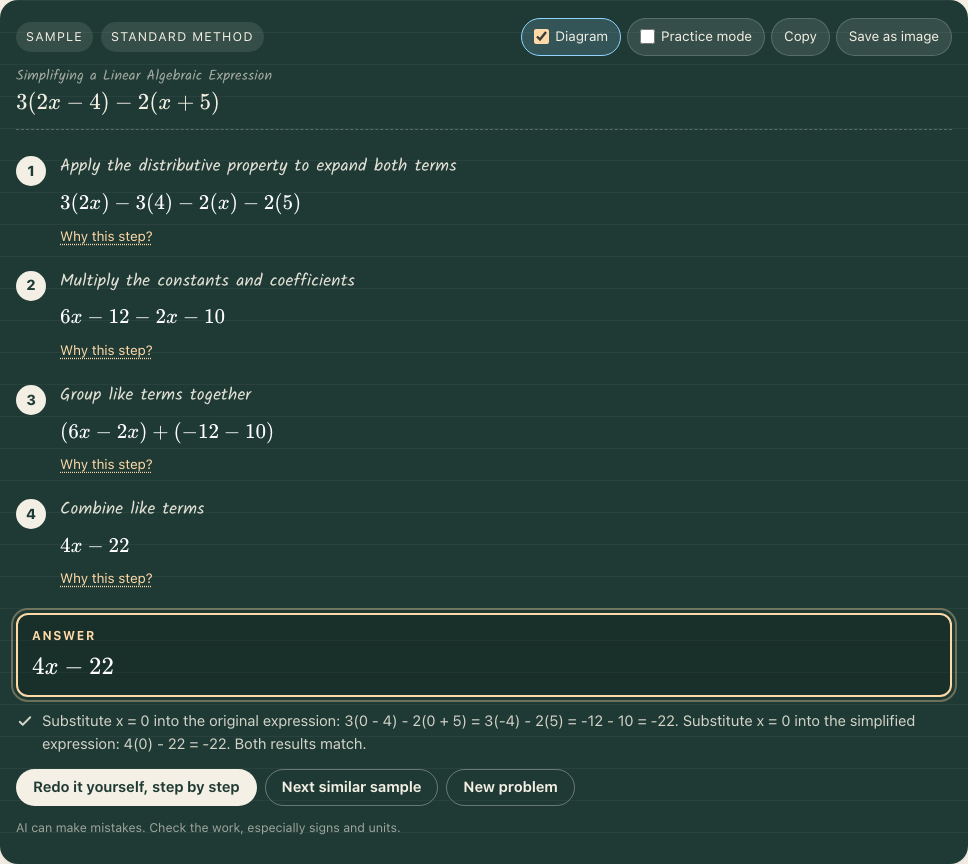
1. Simplify 3(2x - 4) - 2(x + 5)
Apply the distributive property to expand both terms3*(2x) - 3*(4) - 2*(x) - 2*(5)Multiply each term inside the parentheses by the factor in front of it.
Multiply the constants and coefficients6x - 12 - 2x - 10Compute the products: 3 * 2x = 6x, 3 * 4 = 12, and 2 * 5 = 10.
Group like terms together(6x - 2x) + (-12 - 10)Rearrange the expression to place variable terms together and constant terms together.
Combine like terms4x - 22Subtract 2x from 6x to get 4x, and combine the constants -12 and -10 to get -22.
Answer:4x - 22
Check: Substitute x = 0 into the original expression: 3(0 - 4) - 2(0 + 5) = 3(-4) - 2(5) = -12 - 10 = -22. Substitute x = 0 into the simplified expression: 4(0) - 22 = -22. Both results match.
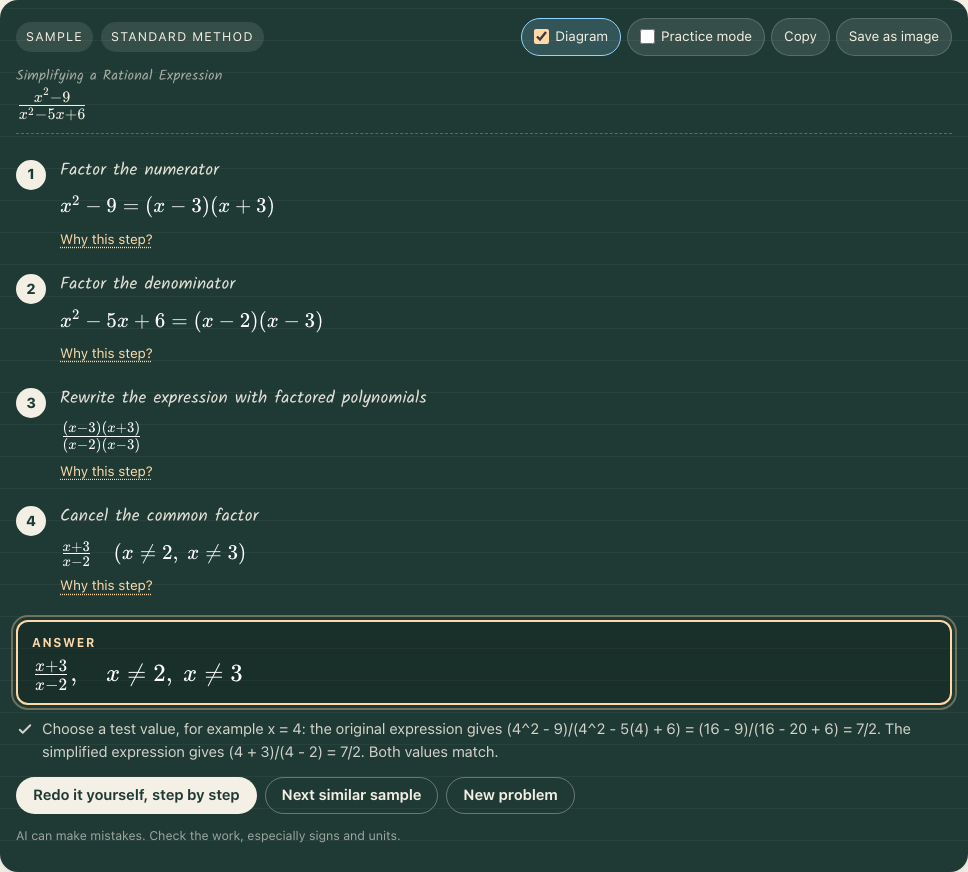
Factor the numeratorx^2 - 9 = (x - 3)(x + 3)The numerator is a difference of two squares, a^2 - b^2 = (a - b)(a + b).
Factor the denominatorx^2 - 5x + 6 = (x - 2)(x - 3)Find two numbers that multiply to 6 and add to -5, which are -2 and -3.
Rewrite the expression with factored polynomials((x - 3)(x + 3)) / ((x - 2)(x - 3))Substitute the factored forms of the numerator and denominator into the original fraction.
Cancel the common factor(x + 3)/(x - 2), for x ≠ 2 and x ≠ 3Divide both numerator and denominator by the common factor (x - 3). The original denominator (x - 2)(x - 3) is zero at x = 2 and x = 3, so both values stay excluded even though the factor (x - 3) cancelled.
Answer:(x + 3)/(x - 2), x ≠ 2, x ≠ 3
Check: Choose a test value, for example x = 4: the original expression gives (4^2 - 9)/(4^2 - 5(4) + 6) = (16 - 9)/(16 - 20 + 6) = 7/2. The simplified expression gives (4 + 3)/(4 - 2) = 7/2. Both values match.
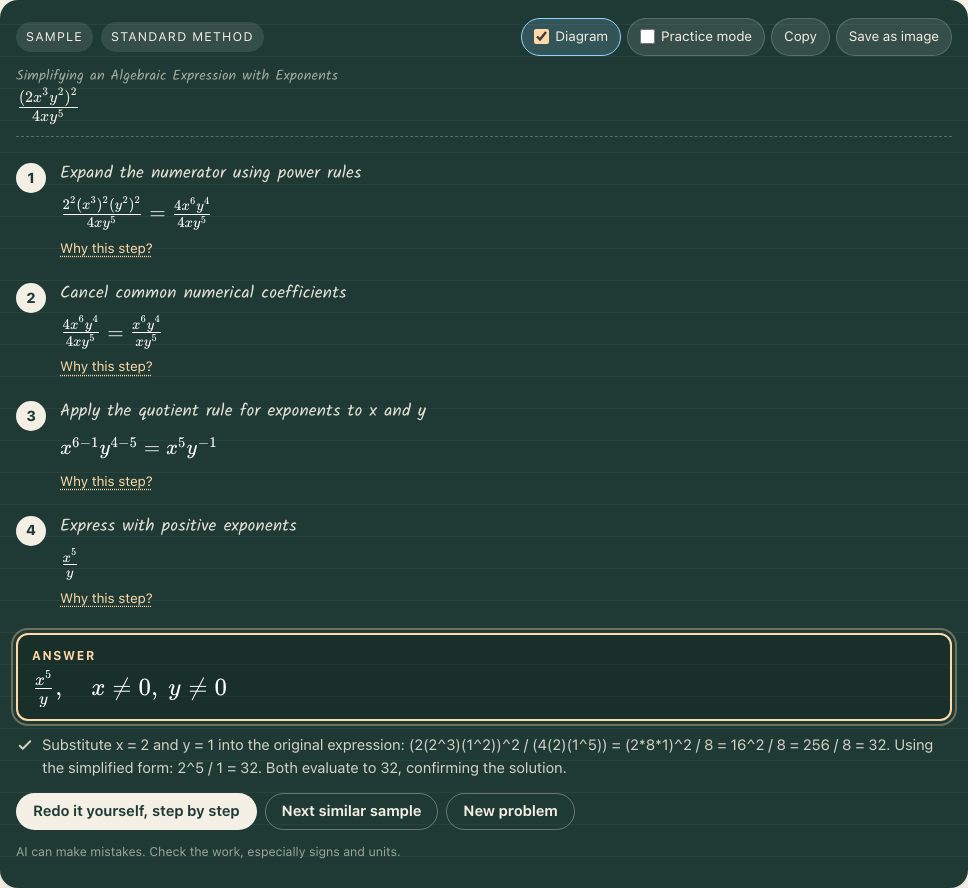
Expand the numerator using power rules(2^2 * (x^3)^2 * (y^2)^2) / (4xy^5) = (4x^6 y^4) / (4xy^5)Apply the power of a product rule (ab)^n = a^n b^n and the power of a power rule (a^m)^n = a^(mn) to the numerator.
Cancel common numerical coefficients(4x^6 y^4) / (4xy^5) = (x^6 y^4) / (xy^5)Divide both numerator and denominator by 4.
Apply the quotient rule for exponents to x and yx^(6-1) * y^(4-5) = x^5 * y^(-1)Subtract the exponent of each variable in the denominator from the exponent in the numerator using a^m / a^n = a^(m-n).
Express with positive exponentsx^5 / yRewrite terms with negative exponents using the rule y^(-1) = 1/y. The original expression has x and y in the denominator (4xy^5), so x and y cannot be 0, and that stays true after simplifying.
Answer:x^5 / y (x ≠ 0, y ≠ 0)
Check: Substitute x = 2 and y = 1 into the original expression: (2(2^3)(1^2))^2 / (4(2)(1^5)) = (2*8*1)^2 / 8 = 16^2 / 8 = 256 / 8 = 32. Using the simplified form: 2^5 / 1 = 32. Both evaluate to 32, confirming the solution.
Expand the squared binomial2(x^2 + 6x + 9) - (x - 1)(x + 4)Use the formula (a + b)^2 = a^2 + 2ab + b^2 to expand (x + 3)^2.
Expand the product of binomials2(x^2 + 6x + 9) - (x^2 + 3x - 4)Multiply the two binomials using the FOIL method: (x - 1)(x + 4) = x^2 + 4x - x - 4 = x^2 + 3x - 4.
Distribute constants and signs2x^2 + 12x + 18 - x^2 - 3x + 4Distribute 2 into the first group and distribute the negative sign into the second group.
Combine like termsx^2 + 9x + 22Group and add coefficients of like powers of x: (2 - 1)x^2 + (12 - 3)x + (18 + 4).
Answer:x^2 + 9x + 22
Check: Substitute x = 0 into both the original expression and the simplified result: 2(0 + 3)^2 - (0 - 1)(0 + 4) = 2(9) - (-4) = 18 + 4 = 22. In the simplified expression: 0^2 + 9(0) + 22 = 22. Both values match.
Choose an easy number such as 0, 1 or 2 and put it into the original expression and into your answer. If the two results differ, something went wrong. Avoid any value that makes a denominator zero.
Why some answers carry a restriction
Simplifying does not remove values the original could not take. In the fraction examples the original denominator contains x or y, so the answers keep x ≠ 0, y ≠ 0 or x ≠ 2, x ≠ 3.
Mistakes the steps help you catch
Losing a minus sign when it sits in front of a bracket.
Squaring a bracket as if (x + 3)² were x² + 9. It is x² + 6x + 9.
Cancelling terms across a fraction bar instead of factors.
Use it to learn the method. Try the problem on paper first, then compare your lines with the steps. The first line where you differ is the thing to practise. Solutions are written by an AI model and can contain mistakes, so keep the check line in the habit.
FAQ
What does simplify mean in algebra?
Rewrite an expression in an equivalent, shorter form. There is no equals sign and no answer to find, so the result is another expression, such as 4x − 22.
Does it show each step?
Yes. Every line is one move, such as applying the distributive property or combining like terms, with a one-line reason you can read.
Can it simplify fractions with variables?
Yes. The rational expression example factors the top and bottom, cancels the common factor and keeps the restrictions x ≠ 2 and x ≠ 3 from the original denominator.
How do I know the answer is right?
Each solution ends with a check that substitutes a test value into the original and the simplified form. Try a second value yourself if the stakes are high.
Is it free?
Yes, 3 full solutions a day with no account. The examples on this page do not count against that.