Algebra solver factoring: factor polynomials with steps
Factor a polynomial and see every step: pull out the greatest common factor, split a trinomial with the ac method, use the difference of squares or cubes, or group four terms. This algebra solver for factoring multiplies the factors back out as its check.
photo
We read the problem from the picture.
or type it
Free: 3 problems a day. Sample problems never count.
Recent
Try a sample
TypedStandard method
Answer
AI can make mistakes. Check the work, especially signs and units.
We read:Wrong? Edit the text box and solve again.
You've used today's 3 free solves
Come back tomorrow, or go unlimited with Plus: every step explained, another method on demand, save solutions as images.
Factoring is easier with a fixed order. First pull out the greatest common factor, because it makes every later step smaller. Then count the terms. With two terms, look for a difference of squares or a sum or difference of cubes. With three terms, look for two numbers that fit the ac method. With four terms, try grouping the terms in pairs. Finally, check whether any factor can be factored again.
This algebra solver for factoring follows that order and names the method on each step, so the pattern becomes familiar rather than a guess. The four worked examples below match the four cases: a trinomial, a difference of cubes, a polynomial with a common factor, and a four-term polynomial.
How to use it
Type the polynomial after the word factor, using ^ for powers, for example Factor x^3 - 27.
Add "completely" if you want it broken down as far as it goes.
Read which method the solver chooses and why: GCF, ac method, a special formula, or grouping.
Expand the answer yourself, or read the check line, and confirm you get the original polynomial back.
Algebra solver factoring: worked examples step by step
Each example is the solver's own output for the problem shown, and each final answer was checked separately with a computer algebra system. Tap the link under an example to run it on the board at the top of the page.
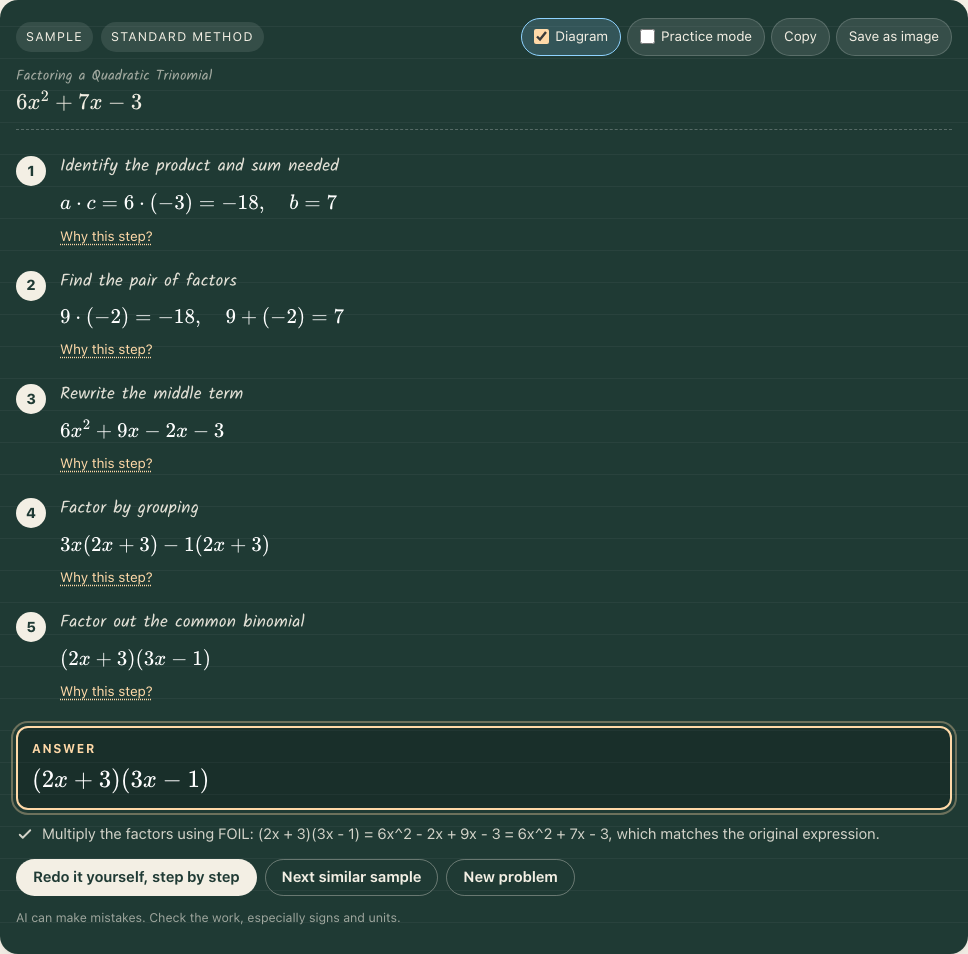
1. Factor 6x^2 + 7x - 3
Identify the product and sum neededa * c = 6 * (-3) = -18, b = 7We look for two numbers that multiply to -18 and add up to 7.
Find the pair of factors9 * (-2) = -18, 9 + (-2) = 7The integers 9 and -2 satisfy both conditions.
Rewrite the middle term6x^2 + 9x - 2x - 3Split the linear term 7x into 9x - 2x.
Factor by grouping3x(2x + 3) - 1(2x + 3)Factor out the greatest common factor from each pair of terms.
Factor out the common binomial(2x + 3)(3x - 1)Both groups share the factor (2x + 3), which can be factored out.
Answer:(2x + 3)(3x - 1)
Check: Multiply the factors using FOIL: (2x + 3)(3x - 1) = 6x^2 - 2x + 9x - 3 = 6x^2 + 7x - 3, which matches the original expression.
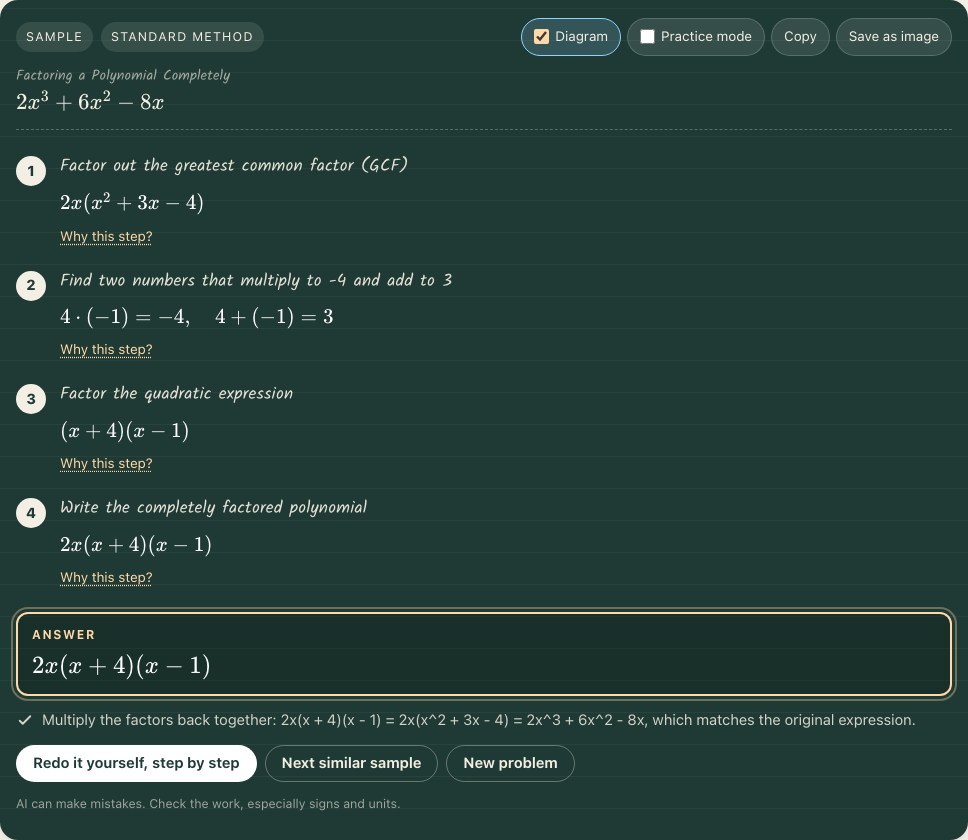
Factor out the greatest common factor (GCF)2x(x^2 + 3x - 4)Each term shares a common factor of 2x, so we factor 2x out from the polynomial.
Find two numbers that multiply to -4 and add to 34 * (-1) = -4, 4 + (-1) = 3To factor the quadratic x^2 + 3x - 4, we look for two integers whose product is -4 and whose sum is 3, which are 4 and -1.
Factor the quadratic expression(x + 4)(x - 1)Using the values 4 and -1, the quadratic trinomial factors into (x + 4)(x - 1).
Write the completely factored polynomial2x(x + 4)(x - 1)Combine the GCF with the factored quadratic factors.
Answer:2x(x + 4)(x - 1)
Check: Multiply the factors back together: 2x(x + 4)(x - 1) = 2x(x^2 + 3x - 4) = 2x^3 + 6x^2 - 8x, which matches the original expression.
Group the terms into two pairs(x^3 + 3x^2) - (4x + 12)Split the four terms into two groups of two terms to find common factors in each group.
Factor out the greatest common factor from each groupx^2(x + 3) - 4(x + 3)The first group shares a common factor of x^2, and the second group shares a common factor of -4.
Factor out the common binomial factor(x^2 - 4)(x + 3)Both terms share the binomial factor (x + 3), which can be factored out.
Factor the difference of squares(x - 2)(x + 2)(x + 3)The factor (x^2 - 4) is a difference of two squares, a^2 - b^2 = (a - b)(a + b), where a = x and b = 2.
Answer:(x - 2)(x + 2)(x + 3)
Check: Expand (x - 2)(x + 2)(x + 3): (x^2 - 4)(x + 3) = x^3 + 3x^2 - 4x - 12, which matches the original expression.
Factoring is the reverse of multiplying, so the check is to multiply the factors out and compare with the original. If you get the same polynomial, the factoring is right. If not, the mismatch usually points at the step: a sign in the middle term, or a missing common factor.
Mistakes the steps help you catch
Forgetting the common factor and stopping early, for example leaving x² + 3x − 4 inside 2x(x² + 3x − 4).
Choosing two numbers with the right product but the wrong sum in the ac method.
Taking out a negative from only one group when grouping.
Treating a sum of squares as factorable. Over the real numbers, x² + 9 is not.
Use it to learn the method. Try the problem on paper first, then compare your lines with the steps. The first line where you differ is the thing to practise. Solutions are written by an AI model and can contain mistakes, so keep the check line in the habit.
FAQ
What if the polynomial does not factor?
Some polynomials cannot be factored with whole numbers, for example x² + 1. A correct answer then says so instead of inventing factors. Multiply back to check any factors you are given.
Does it show the ac method?
Yes. The trinomial example finds the product and sum needed, rewrites the middle term, factors by grouping, and then takes out the common binomial.
Can it factor a difference of cubes?
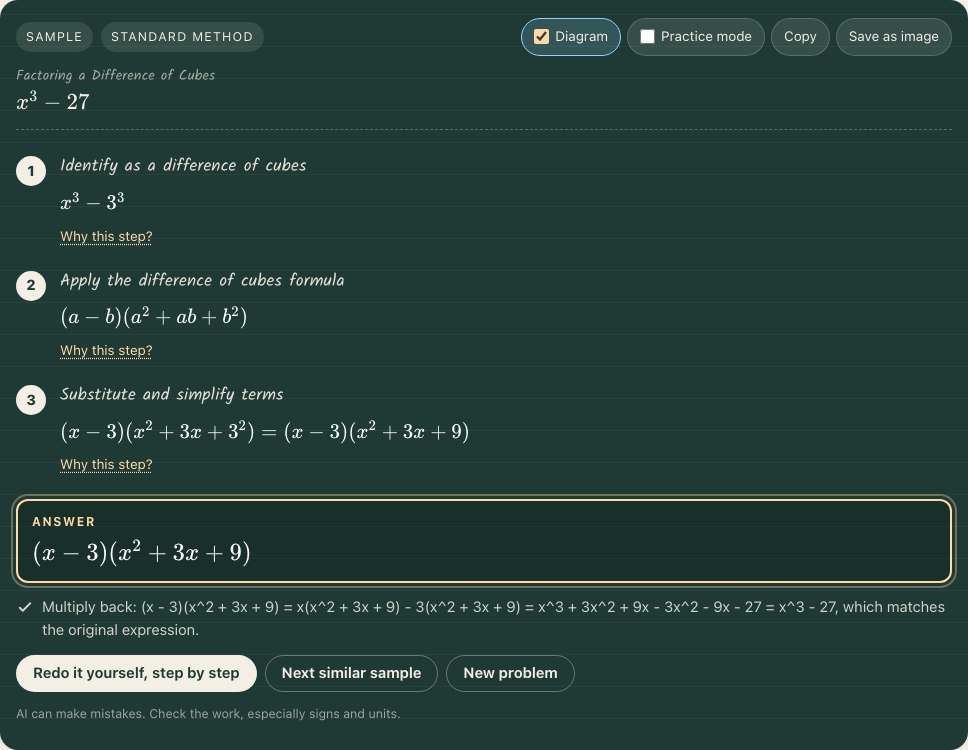
Yes. The example x³ − 27 is identified as a difference of cubes, and the formula is written before the numbers are substituted.
Does it factor completely?
Ask for it ("factor completely") and it keeps going until no factor can be split further, as in the 2x³ + 6x² − 8x example.
Is it free?
Yes, 3 full solutions a day with no account. Opening an example from this page does not use one.