Algebra fraction solver: an algebra solver with fractions
This algebra fraction solver is an algebra solver with fractions built in. Give it an equation such as x/2 + x/3 = 5 and it finds the common denominator, clears the fractions, solves what is left and checks the answer. When x is in a denominator it also says which values are not allowed. Type the equation or take a photo.
photo
We read the problem from the picture.
or type it
Free: 3 problems a day. Sample problems never count.
Recent
Try a sample
TypedStandard method
Answer
AI can make mistakes. Check the work, especially signs and units.
We read:Wrong? Edit the text box and solve again.
You've used today's 3 free solves
Come back tomorrow, or go unlimited with Plus: every step explained, another method on demand, save solutions as images.
Algebra solver with fractions: the method it follows
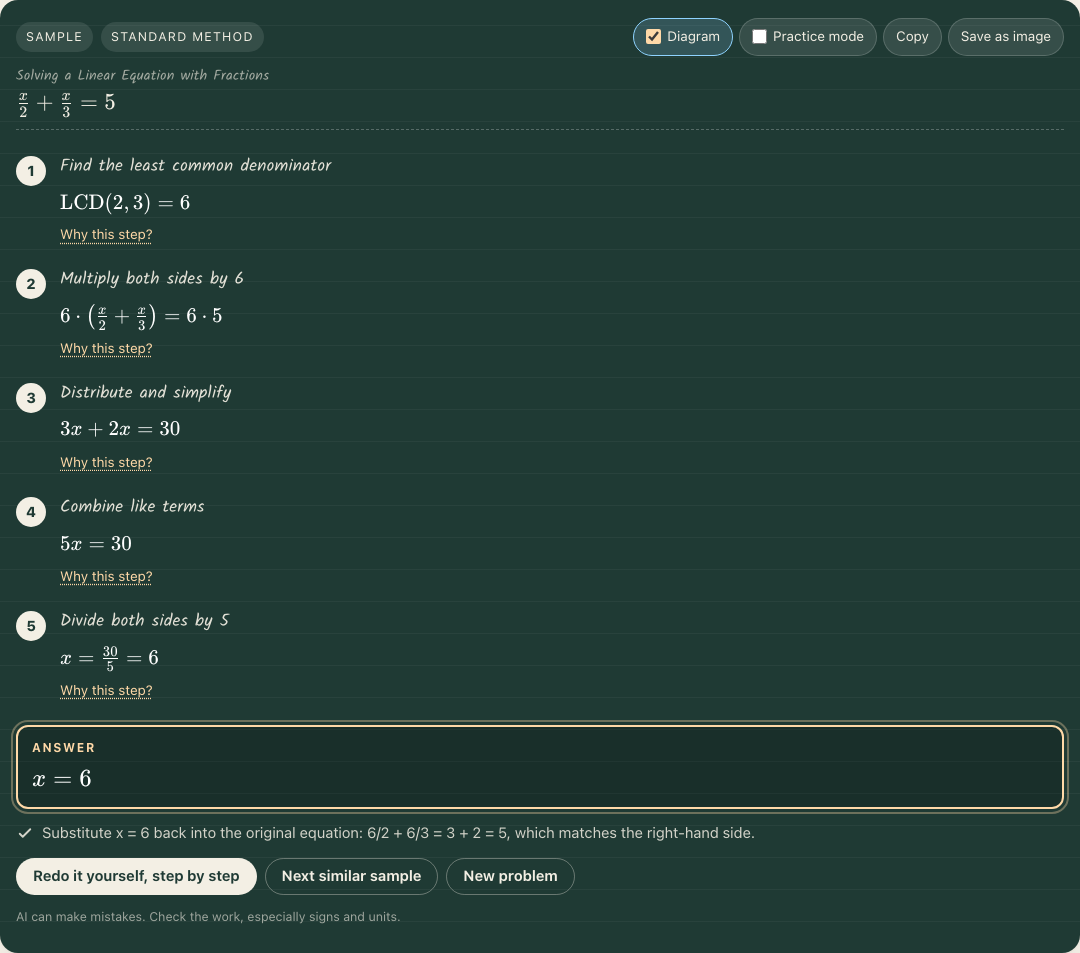
An equation with fractions looks harder than it is, because there is one idea behind every case: multiply both sides by a number that makes every denominator disappear. That number is the least common denominator. For x/2 + x/3 = 5 it is 6, and multiplying by 6 turns the equation into 3x + 2x = 30, an ordinary linear equation.
This algebra solver with fractions writes each of those moves on its own line with a one-sentence reason. It handles two kinds of problem. When the unknown is in a denominator, the equation is only defined for some values of x, and those values are written down first.
Why denominators with x need a restriction
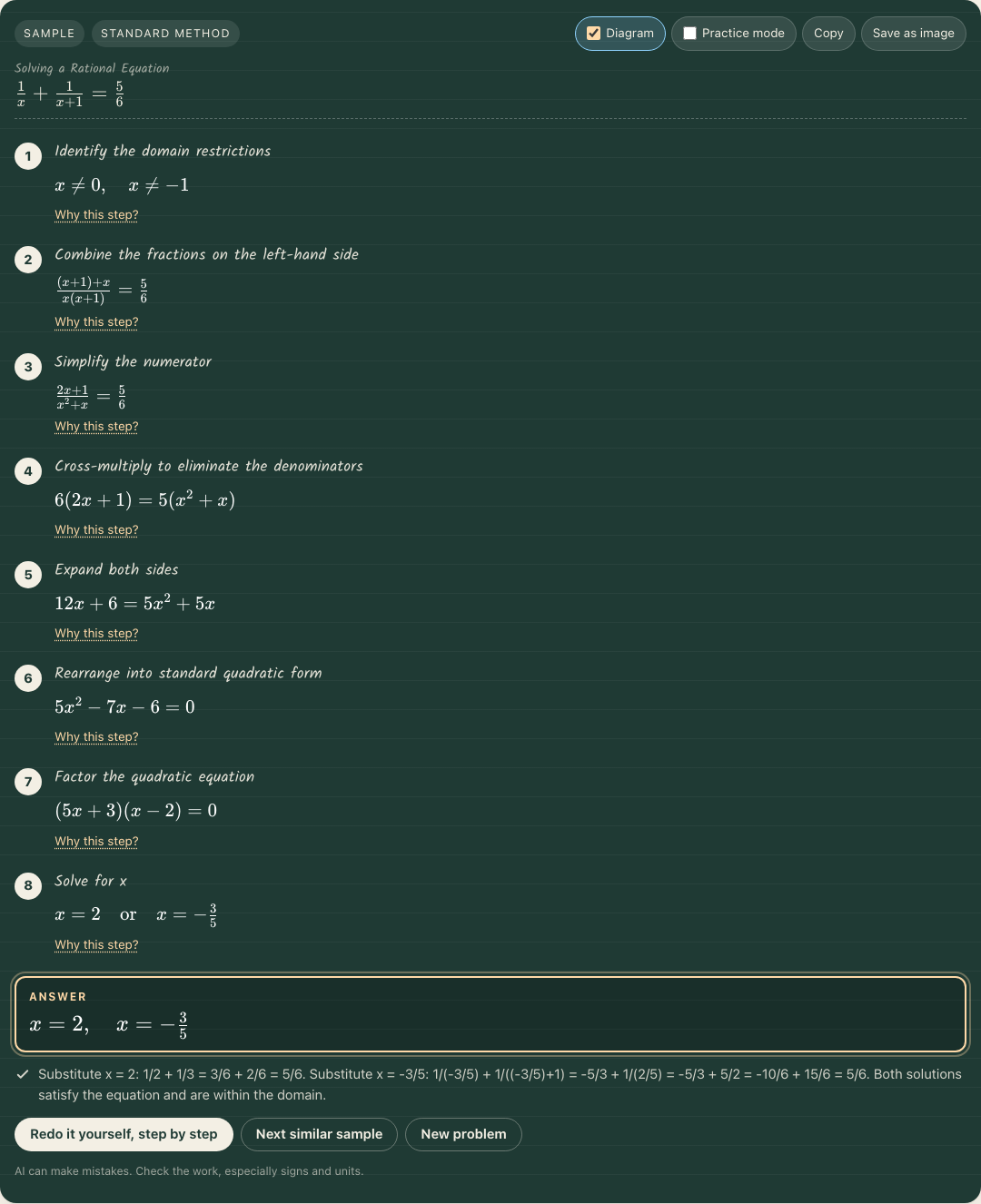
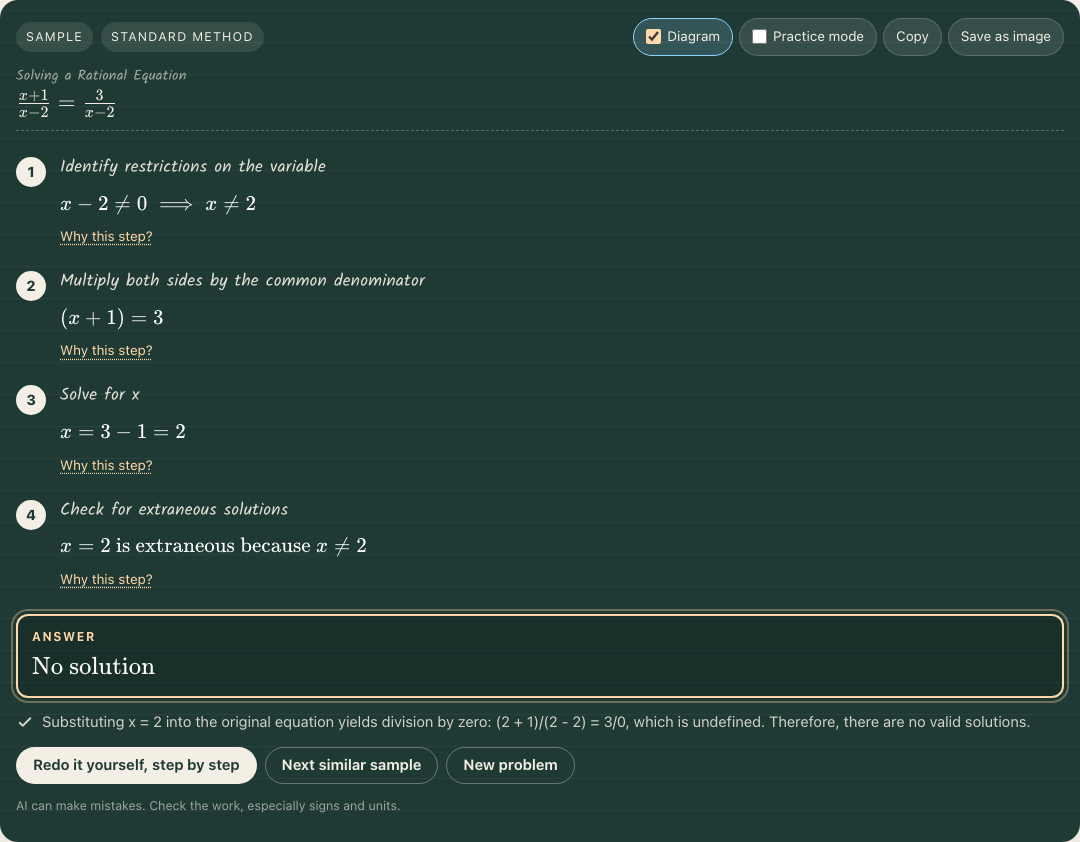
A fraction is undefined when its denominator is zero. In 1/x + 1/(x + 1) = 5/6 the value x = 0 would put zero under the first fraction and x = −1 would put zero under the second, so neither can be a solution, whatever the algebra later produces. In the last example, (x + 1)/(x − 2) = 3/(x − 2), the algebra gives x = 2, but 2 is exactly the value that makes the denominator zero. The equation has no solution, and the solver says so instead of reporting 2.
How to use it
Type each fraction with a slash and put the top or bottom in brackets when it has more than one term, for example (2x - 1)/3.
Add "for x" if the equation has more than one letter.
Read the first step. With x in a denominator it lists the values x cannot be, and those are ruled out for the rest of the solution.
Check the last line against the original equation, and compare the answer with the list of values x cannot be.
Algebra fraction solver: worked examples with checks
Each example is the solver's own output for the equation shown. We worked every one out by hand as well, and the answers match. Use the link under an example to run it on the board above.
1. Solve x/2 + x/3 = 5 for x
Find the least common denominatorLCD(2, 3) = 6Determine the least common multiple of the denominators 2 and 3 to eliminate the fractions.
Multiply both sides by 66 * (x/2 + x/3) = 6 * 5Multiply every term on both sides by the LCD to clear the denominators.
Distribute and simplify3x + 2x = 30Apply the distributive property: 6*(x/2) simplifies to 3x, and 6*(x/3) simplifies to 2x.
Combine like terms5x = 30Add the coefficients of x together: 3 + 2 = 5.
Divide both sides by 5x = 30 / 5 = 6Divide by 5 to isolate the variable x.
Answer:x = 6
Check: Substitute x = 6 back into the original equation: 6/2 + 6/3 = 3 + 2 = 5, which matches the right-hand side.
Multiply both sides by 1212 * ((2x - 1)/3) - 12 * ((x + 2)/4) = 12 * 1The least common multiple of 3 and 4 is 12, so multiplying both sides by 12 clears the fractions.
Simplify the products4(2x - 1) - 3(x + 2) = 12Divide 12 by each denominator to simplify the terms.
Expand the parentheses8x - 4 - 3x - 6 = 12Distribute 4 and -3 across their respective parentheses.
Combine like terms on the left side5x - 10 = 12Combine the x-terms (8x - 3x = 5x) and constant terms (-4 - 6 = -10).
Add 10 to both sides5x = 22Isolate the variable term by adding 10 to both sides.
Divide both sides by 5x = 22/5Divide by the coefficient of x to find the final value.
Answer:x = 22/5 = 4.4
Check: Substitute x = 22/5 into the original equation: (2(22/5) - 1)/3 - (22/5 + 2)/4 = (39/5)/3 - (32/5)/4 = 13/5 - 8/5 = 5/5 = 1. The left side equals the right side, confirming the solution.
Identify restrictions on the variablex - 2 != 0 implies x != 2The denominator cannot equal zero, which means x = 2 is not in the domain.
Multiply both sides by the common denominatorx + 1 = 3Multiply both sides by (x - 2) to eliminate the denominators.
Solve for xx = 3 - 1 = 2Subtract 1 from both sides to isolate x.
Check for extraneous solutionsx = 2 is extraneous because x != 2Since this answer makes the original denominators zero, it must be rejected.
Answer:No solution
Check: Substituting x = 2 into the original equation yields division by zero: (2 + 1)/(2 - 2) = 3/0, which is undefined. Therefore, there are no valid solutions.
Dropping a bracket: in (2x − 1)/3 − (x + 2)/4, multiplying by 12 gives 4(2x − 1) − 3(x + 2), and the minus sign changes the second bracket.
Cross-multiplying when a side has several terms. It only works when each side is a single fraction.
Use it to learn the method. Try the problem on paper first, then compare your lines with the steps. The first line where you differ is the thing to practise. Solutions are written by an AI model and can contain mistakes, so keep the check line in the habit.
FAQ
What does an algebra fraction solver do?
It solves equations that contain fractions. It finds the least common denominator, multiplies every term by it, solves the resulting equation, and checks the answer in the original.
What if x is in the denominator?
The solver first lists the values x cannot take, because they make a denominator zero. After solving, it rejects any answer on that list. If every answer is rejected, the equation has no solution.
Can I cross-multiply instead?
Only when each side is one fraction, as in a/b = c/d. Otherwise clear the denominators with the common denominator, as the examples do.
Is it free?
Yes. You get 3 full step-by-step solutions a day with no account.