Algebra elimination solver: an algebra system solver with steps
Use this algebra elimination solver, an algebra system solver, to solve a system by the elimination method, with two equations or three, and see each step: which variable to cancel, what to multiply, whether to add or subtract, and the check at the end. It also spots the cases with no solution and infinitely many. Type the system or take a photo.
photo
We read the problem from the picture.
or type it
Free: 3 problems a day. Sample problems never count.
Recent
Try a sample
TypedStandard method
Answer
AI can make mistakes. Check the work, especially signs and units.
We read:Wrong? Edit the text box and solve again.
You've used today's 3 free solves
Come back tomorrow, or go unlimited with Plus: every step explained, another method on demand, save solutions as images.
Elimination turns two equations in two unknowns into one equation in one unknown. First choose a variable to remove. Second, make its coefficients equal in size by multiplying one or both equations by a number. Third, add the equations if the coefficients are opposite, or subtract them if they are the same. Fourth, solve the one-variable equation that is left, then substitute back to find the other variable. This algebra elimination solver writes each of these moves on its own line, with a short reason.
Add or subtract: how to decide
If the two terms you want to remove have opposite signs, such as +3y and −3y, add. If they have the same sign, such as 6x and 6x, subtract. When the coefficients are different sizes, multiply first. If neither coefficient divides the other, as in the second example below, multiply both equations by numbers that make the coefficients match at the least common multiple.
The worked examples below use two equations. For three, type all three into the same box, for example x + y + z = 6, x − y + z = 2, x + 2y − z = 2. Elimination with three equations removes one variable from two pairs of equations, which leaves two equations in two unknowns. Here, subtracting the second from the first gives 2y = 4, so y = 2; adding the first and third gives 2x + 3y = 8, so x = 1; then z = 6 − 1 − 2 = 3. Check: 1 − 2 + 3 = 2 and 1 + 4 − 3 = 2. For larger systems solved with matrices and rank, use the linear algebra solver.
How to use it
Type the two equations separated by a comma, and start with "solve by elimination", for example 2x + 3y = 12, 4x - 3y = 6.
Read the first step: it names the variable to eliminate and why.
Follow each multiply and each add or subtract. The solver says what happened to the constant on the right as well.
Read the check line, and look for the phrases "no solution" or "infinitely many" if the variables cancel together.
Algebra elimination solver: worked examples step by step
Worked by hand in the format the solver uses, each answer checked in the original equations.
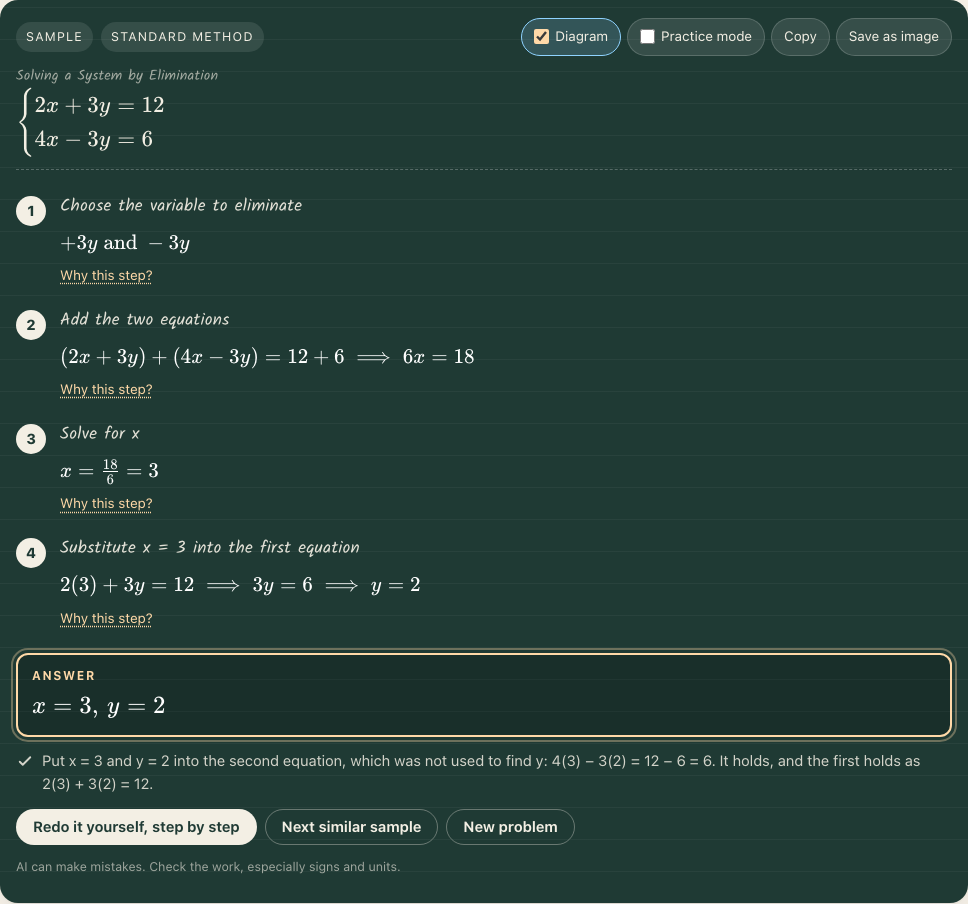
Choose the variable to eliminate+3y and -3yThe y-terms already have opposite coefficients, so adding the equations cancels y with no multiplying.
Add the two equations(2x + 3y) + (4x - 3y) = 12 + 6, so 6x = 18Add left sides together and right sides together.
Solve for xx = 18 / 6 = 3Divide both sides by 6.
Substitute x = 3 into the first equation2(3) + 3y = 12, so 3y = 6 and y = 2Any equation of the system works.
Answer:x = 3, y = 2
Check: Put x = 3 and y = 2 into the second equation, which was not used to find y: 4(3) − 3(2) = 12 − 6 = 6. It holds, and the first holds as 2(3) + 3(2) = 12.
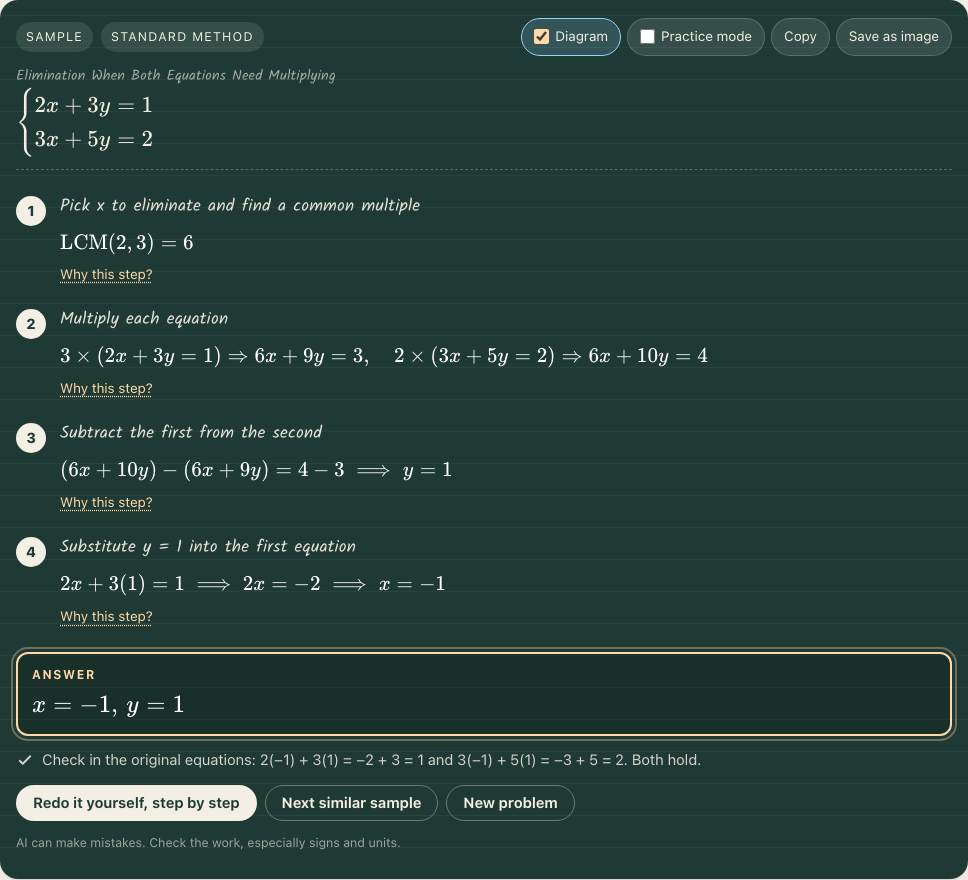
Pick x to eliminate and find a common multipleLCM(2, 3) = 6The x-coefficients are 2 and 3.
Multiply each equation3*(2x + 3y = 1) gives 6x + 9y = 3; 2*(3x + 5y = 2) gives 6x + 10y = 4Multiply every term of an equation, including the constant, so it stays true.
Subtract the first from the second(6x + 10y) - (6x + 9y) = 4 - 3, so y = 1The equal x-terms cancel when subtracting.
Substitute y = 1 into the first equation2x + 3(1) = 1, so 2x = -2 and x = -1Solve the resulting one-variable equation.
Answer:x = -1, y = 1
Check: Check in the original equations: 2(−1) + 3(1) = −2 + 3 = 1 and 3(−1) + 5(1) = −3 + 5 = 2. Both hold.
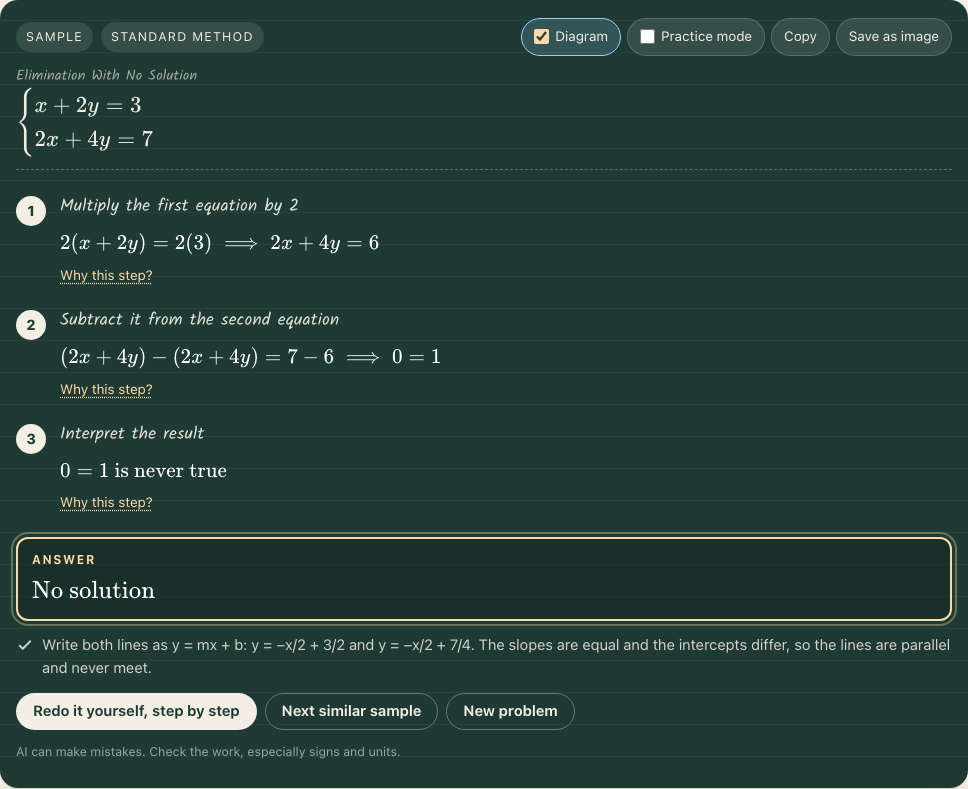
Multiply the first equation by 22(x + 2y) = 2(3), so 2x + 4y = 6This makes the x- and y-coefficients equal to those of the second equation.
Subtract it from the second equation(2x + 4y) - (2x + 4y) = 7 - 6, so 0 = 1Both variables cancel at once and what is left is false.
Interpret the result0 = 1 is never trueA false statement after eliminating means no pair (x, y) satisfies both equations.
Answer:No solution
Check: Write both lines as y = mx + b: y = −x/2 + 3/2 and y = −x/2 + 7/4. The slopes are equal and the intercepts differ, so the lines are parallel and never meet.
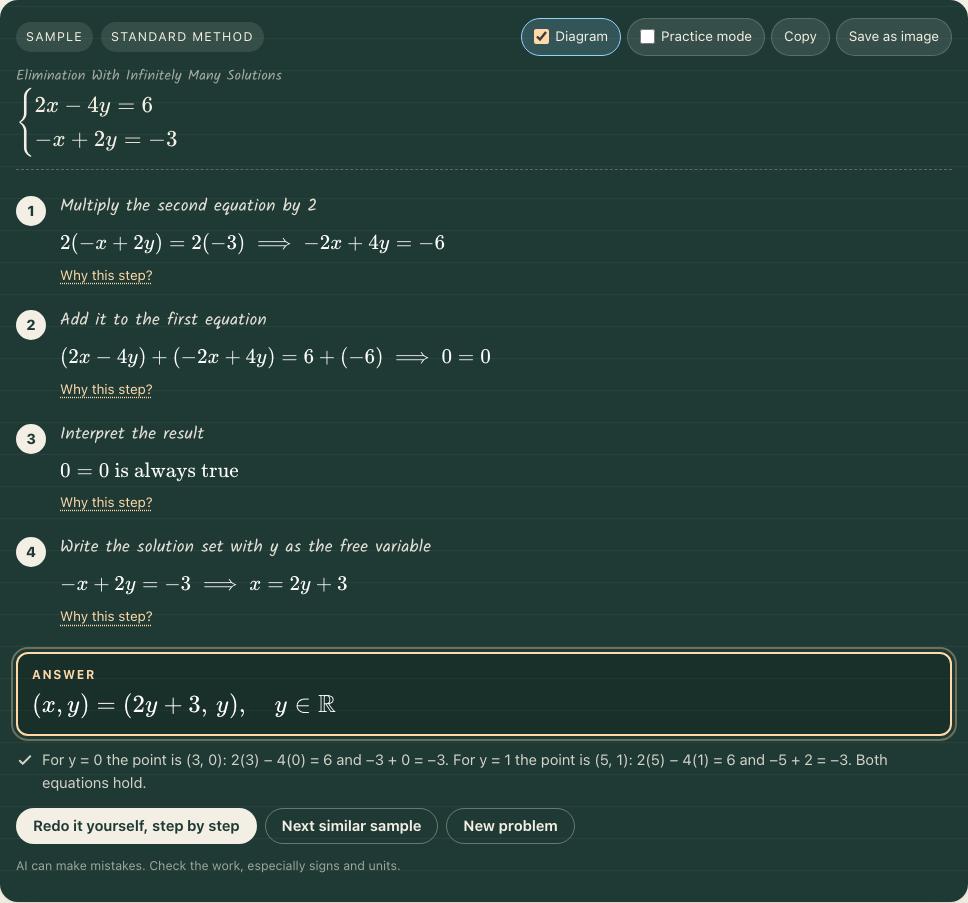
Multiply the second equation by 22(-x + 2y) = 2(-3), so -2x + 4y = -6This makes the x-coefficient the opposite of the first equation.
Add it to the first equation(2x - 4y) + (-2x + 4y) = 6 + (-6), so 0 = 0Both variables cancel and what is left is always true.
Interpret the result0 = 0 is always trueThe two equations describe the same line, so every point on it is a solution.
Write the solution set with y as the free variable-x + 2y = -3, so x = 2y + 3Solve either equation for x in terms of y.
Answer:(x, y) = (2y + 3, y), y any real number
Check: For y = 0 the point is (3, 0): 2(3) − 4(0) = 6 and −3 + 0 = −3. For y = 1 the point is (5, 1): 2(5) − 4(1) = 6 and −5 + 2 = −3. Both equations hold.
When every algebra system solver step cancels both variables
If both variables vanish, what remains has no letters. A false statement such as 0 = 1 means parallel lines and no solution; a true one such as 0 = 0 means the same line and infinitely many solutions.
Mistakes the steps help you catch
Multiplying the variable terms but not the constant on the right.
Subtracting when the signs call for adding. Stack the equations in columns.
Use it to learn the method. Try the problem on paper first, then compare your lines with the steps. The first line where you differ is the thing to practise. Solutions are written by an AI model and can contain mistakes, so keep the check line in the habit.
FAQ
What is the elimination method in algebra?
It solves a system of equations by adding or subtracting the equations so that one variable cancels, which leaves one equation with one unknown. The other variable is then found by substitution.
When should I use elimination instead of substitution?
Elimination is usually quicker when both equations have the variables on the left in standard form, because you can line them up and add or subtract. Substitution suits a system where one variable is already isolated.
What does it mean if both variables cancel?
If what remains is false, like 0 = 1, there is no solution because the lines are parallel. If it is true, like 0 = 0, there are infinitely many solutions because the equations describe the same line.
Is it free?
Yes. You get 3 full step-by-step solutions a day with no account. The examples on this page do not count against that.